 Leah Hennig
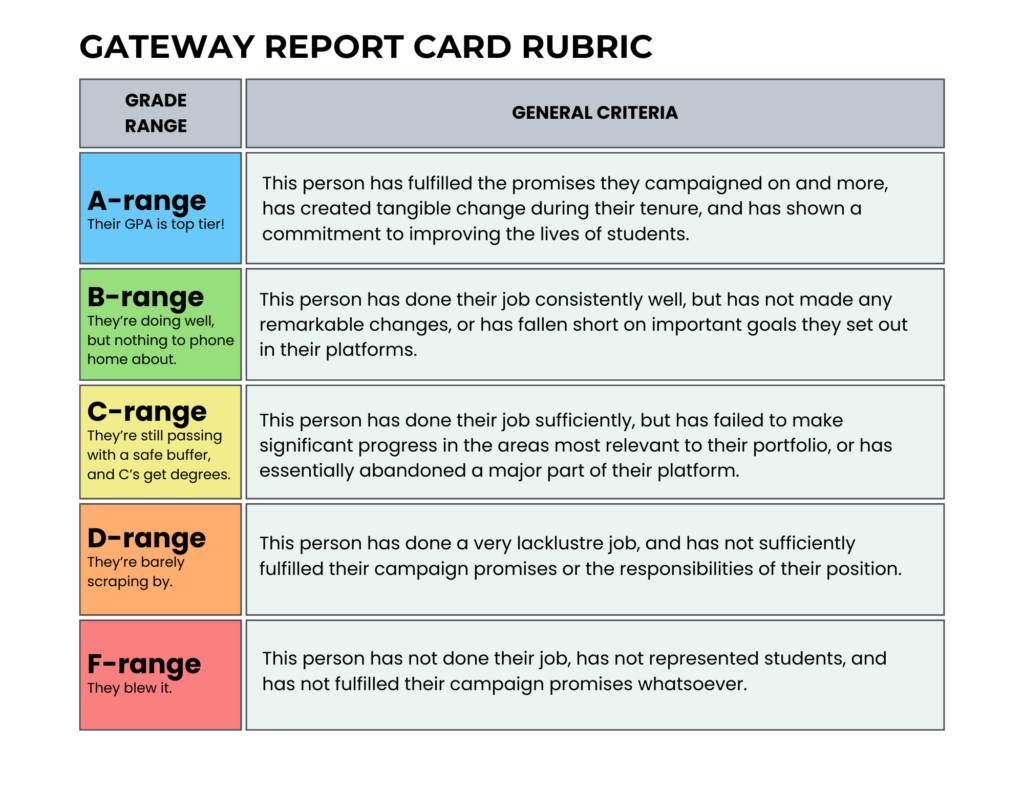
Each year, The Gateway publishes an evaluation of the Students’ Union Executive and the Board of Governors representative. It’s impossible to discuss every aspect of their tenures, so these reports are largely based on the major components of the platform each executive campaigned on, and the most significant responsibilities of their respective positions. The grading rubric can be found at the bottom of the article.
And if you’re short for time, check out our TL;DR for a bite-sized breakdown towards the end of the article.
Katie Tamsett: C
For the University of Alberta Students’ Union (UASU), the vice-president (academic) (VPA) is responsible for one of the most complex portfolios on campus. The role spans advising, accommodations, academic regulations, faculty governance, and student advocacy — often within systems resistant to quick change. This year, Katie Tamsett approached the role with seriousness and clear intent. While many of her priorities were well-chosen and thoughtfully developed, the gap between groundwork and concrete outcomes — and controversy around consultation — keeps her term in the C range.
Strong groundwork on academic advocacy
Tamsett’s central focus was improving how students navigate academic concerns — and on this front, she made meaningful progress. One of her most tangible initiatives was the Academic Feedback Program, designed to help students understand where to take concerns, how to raise them, and how to advocate for themselves. Rather than proposing unrealistic standardization, Tamsett focused on practical tools students could actually use.
She also pushed forward conversations around how student feedback — particularly SPOT surveys — is interpreted and acted on. While no sweeping policy changes materialized, she succeeded in keeping the issue alive in governance spaces where it has historically stalled.
Academic advising reform remained a major priority throughout Tamsett’s term. She worked to identify best practices across faculties, emphasized student safety and privacy amid centralized ticketing systems, and raised concerns about accessibility and wait times.
However, advising remains an area where many students continue to report confusion and inconsistent experiences. While Tamsett was candid about the structural complexity of the issue, the lack of visible, campus-wide improvement limits how much credit this file can earn.
Course Materials Access, formerly known as First Day Access, has been a huge topic for the last three years. Tamsett helped get the implementation of the program delayed from fall 2025 to fall 2026. However, that’s where the breakthroughs have ended.
The university has shown an unwillingness to listen to students’ opposition to the program. Not all of that falls on Tamsett, but unfortunately, she has failed to make any further progress on fighting this program.
Controversy and concerns around Indigenous consultation
Tamsett’s term was complicated by accusations that she made dismissive or inappropriate remarks regarding Indigenous students — particularly in the context of governance discussions where concerns were raised about consultation and representation. Tamsett has stated that she consulted Indigenous students at multiple points during her term and acknowledged that Indigenous students face uniquely overlooked challenges on campus. However, the incident exposed deeper tensions around how advocacy is framed and who is meaningfully included in decision-making.
Perception matters in a role built on trust. For some Indigenous students and representatives, the controversy reinforced concerns that consultation can feel reactive rather than embedded.
Ambition without full execution
Several of Tamsett’s platform commitments showed strong ambition but limited follow-through within the term. Work on menstrual accommodations and sexual health focused largely on research, surveys, and awareness-building. Concrete accommodation policies have yet to be implemented.
Similarly, experiential learning initiatives — such as improving undergraduate research access and building clearer opportunity directories — remained in exploratory stages. These efforts were directionally sound, but many did not reach a stage where students could feel their impact directly.
Tamsett also struck an artificial intelligence (AI) task force in October. Unfortunately, it was slow to get off the ground with its first meeting happening in late January. AI is a hot topic right now, and much of what is considered appropriate use varies from instructor to instructor.
Tamsett and this task force are running out of runway to actually get any substantial work done on this issue. Far more could have been done if the task force gotten to work sooner.
Tamsett maintained a consistent presence in academic governance spaces, particularly at General Faculties Council. She successfully defended student representation and worked to improve student participation. Within Council of Faculty Associations (COFA), she prioritized collaboration among Student Representative Associations and improved feedback structures.
Her communication strategy relied on multiple channels — council reports, COFA updates, and executive social media — but updates on high-interest files sometimes lagged behind student expectations. The delayed start of the AI task force further contributed to a sense of unfinished business.
Tamsett identified real problems in the academic system and invested significant effort into addressing them. Her term demonstrated preparation and a strong understanding of governance. However, limited tangible outcomes, slow-moving reforms, and controversy surrounding Indigenous consultation prevented her work from reaching its full potential.
This was a serious and thoughtful term — but one that stopped short of delivering the structural change many students hoped for. That earns a C.
TL;DR: Tamsett tackled important academic issues and laid substantial groundwork, but uneven delivery and controversy around Indigenous consultation tempered her impact. A solid but incomplete term, earning a C.