SU Elections 2026 Q&A: Vice-president (academic)
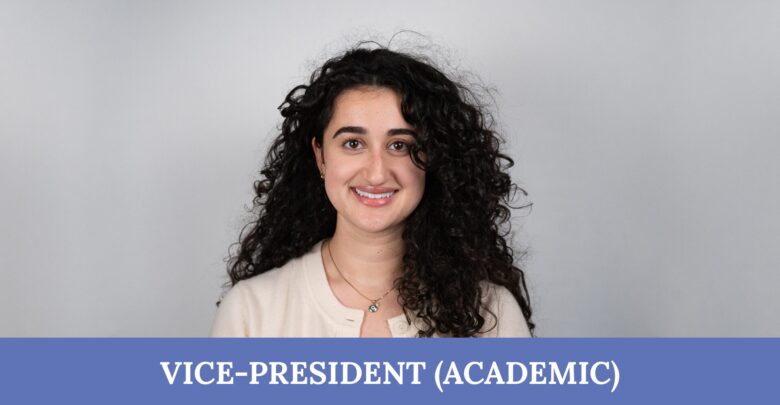
There is one candidate in the 2026 vice-president (academic) race: Susan Huseynova.

 Leah Hennig
 The vice-president (academic) of the University of Alberta Students’ Union (SU) is responsible for all advocacy efforts that impact students’ academic experiences. This role involves collaboration with student faculty and department associates. As well, they participate in various boards and committees, such as the SU Policy Committee, General Faculties Council (GFC), and the Council of Faculty Associations (CoFA).
There is one candidate in the 2026 vice-president (academic) race:
- Susan Huseynova, a second-year immunology infection and political science student
The following interview has been edited for brevity and clarity.
Why have you decided to run for vice-president (academic)?
Susan Huseynova: I decided to run for VPA because over the last year, I served as the VPA for the Interdepartmental Science Students’ Society (ISSS), and I got a real view of what students were dealing with and how often the same issues came across programs. Throughout this role, I wasn’t just sitting in these meetings. I was talking to these students. I was having in-person consultations, and I was working with cross-faculty and also interest-based groups. Even through my consultations, I’ve seen a common theme of academic concerns. What I kept hearing again and again was that students don’t need more vague promises from elected student leaders, they need someone who will take these everyday academic frustrations seriously and then push for the fixes that actually work in practice.
A lot of students feel like the academic side of the university is harder than it needs to be, so policies are unclear and processes are inconsistent, and supports that they need are hard to find until it’s already too late. So if it’s navigating degree requirements or getting timely guidance or dealing with high stakes academic processes when something goes wrong, students need that clarity, that consistency, and that fairness across faculties. I’m running because I know that I can do that work well. I’m comfortable doing that work, doing policy, asking the right questions, bringing evidence forward, and following up until things move. I care about making sure that students can trust that when they raise an academic issue, it won’t just be heard, that it’ll be acted on. So for me, this is about being a reliable advocate, a student-led, practical, and consistent. And I want to be focused on making the academic experience more navigatable, more fair, and more supportive for everyone.
What would you say are the three main takeaways from your platform?
Huseynova: I think the three main takeaways would be affordability, academic clarity, and collaboration. So to break each of those down, affordability has to be something that students feel because the cost of learning is only rising. Students need transparency and real protections when these new models are implemented. I want students to understand what they’re paying, why, and what other choices they have, while also working with the university and the rest of the executive team to explore other financial supports where they’re needed most. I think that this point really alludes to Zero Textbook Cost (ZTC) [program] and Course Material Access program (CMA) as that’s a big part of, I’m assuming, next year’s VPA portfolio.
The second part: academic clarity and fairness. Especially as a classroom changes, students are consistently dealing with inconsistent expectations and uncertainty, and I think artificial intelligence (AI) is the perfect example of that. I want to move us away from the fear and the confusion of using AI to clear faculty-informed guidelines that support learning academic integrity without leaving students guessing and fearful of using AI.
Lastly, I think collaboration is a big piece of my platform. I think a stronger student voice can be heard through better collaboration. I want to improve how faculty associations and student groups connect with the SU, so it’s not just consultation projects that are already decided in the Council of Faculty Associations (CoFA), but also real partnership that builds cross-faculty solutions overall. The way, on some of my platform is student-first advocacy with transparency, lowering barriers, making process clearer, and ensuring students have real voice in the decisions that shape their education.
Students have continued to raise concerns about the Course Material Access program. How would you ensure students’ voices are heard throughout the implementation process?
Huseynova: If elected, the conversation around CMA, ZTC costs will be one of the first priorities of my term. I think that there is room to push back with CMA and have more transparency about the data discrepancy with these projects. After the SU conducted a bit of that digging, it was revealed that there’s a huge percentage of unreported no textbook classes, so it seemed like students are going to benefit hugely from these projects. However, if the data discrepancy is addressed, I think there will be more clarity, not only to students but also to the university about the actual demand of this project. I would want to implement a mandatory survey for academic staff to fill out before students are even applied to these open educational resources (OER) projects, so students can actually know if they benefit from that $259 fee.
I also consulted with various student leaders, and some of them actually told me that, because of their positions, they see what first-years look like, and they know that first-years, when they enter this university, they’re the last people to opt out and even know how to opt out from this sort of program. That being said, if thousands of students aren’t informed on how to opt out of this program that they don’t benefit from, they’ll end up paying more for classes, and the university will be making money just taking advantage of these uninformed students. I also think because the plebiscite going forward, especially in light of it, it will actually dictate what the VPA can do moving forward. So, ultimately, once students report that discrepancy, their usage of it, the university is aware of that data discrepancy, and the results of the plebiscite, I think then there can be a more tangible movement to see how to go about CMA, but for right now, just kind of waiting on those pieces.
How would you approach the challenges posed by AI in academics?
Huseynova: Over the past two years, the VPA work on academic integrity has been making the policy clear and more understandable for students. I think, with the rise of AI, I want to build on that in a way that reflects what’s changing in the classrooms. A key project that I’d take on, I would be strengthening what the student academic integrity policy looks like and that non-disciplinary action resolution. Right now students make small mistakes without the guidance of knowing what kind of AI can be used and having that non-disciplinary action kind of way to go about consequences, it can be attached to a learning moment rather than just a permanent kind of stain on your record.
I think with AI guidance, we can’t afford another academic year where students are learning the AI rules only by getting in trouble. My goal is to have a policy environment where academic integrity is protected, the students are also supported. A big part of it is through my consultations with various faculties, each faculty wants a different thing. The faculty of law wants a zero AI, but then the faculty of science, coming from there, we actually promote the use of AI through statistics and that sort of thing. So I think I really need to get into the role and consult with these teams to see what is being asked and to see if implementing university policy is the best thing to do or a faculty policy, but there definitely needs to be something done this term.
Some students face accessibility challenges or don’t receive the proper academic accommodations. How would you work to improve accessibility and accommodations?
Huseynova: I think looking at this term’s VPA’s work, they focused a lot on the menstrual accommodations and, from my understanding of my consultation with her, what I got that conversation [was that] there’s currently a survey that’s being conducted through the Student Experience Action Plan (SEAP) and through Student Success and Experience (SSE) to better understand what students are experiencing and where the gaps are. My approach would be support that work to completion and make sure that the results are already translated into action and not just a report that sits on a shelf. There’s also been that restructuring of accommodations, the Accommodate platform. So I think through the survey, it can give us insight as to how the new accommodations platform is working this year, and how students are responding to the restructuring and the timeliness of it.
What I also think is important from the survey is, although it may focus on menstrual accommodation experiences, the findings can have a broader value. A lot of the barriers that students face tend to repeat across different accommodation needs, so confusion as to where to go, inconsistent processes between faculties, delays, fears of being dismissed or not knowing what’s reasonable to ask help for. If we can identify those friction points clearly, we can improve how the university handles short-term academic accommodations and support requests more generally and in a way that’s low barrier and consistent. So in practice, what I would push for is clear navigation and communication about what options already exist, a stigma free process that doesn’t make students jump through unnecessary hoops, and consistency across faculties so students are dealing with totally different expectations depending on their program. The goal is simple. Students should be able to reach out early and get the support they need and maintain academic continuity reliably and respectfully.