SU Elections 2026: Interdepartmental Science Students’ Society forum recap
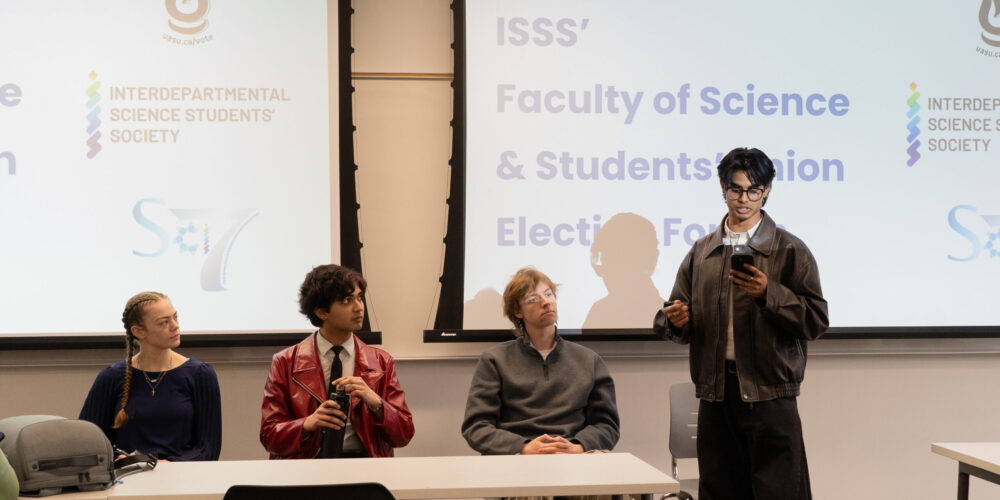
The fourth University of Alberta Students' Union 2026 elections forum was hosted by the Interdepartmental Science Students' Society.

 Leah Hennig
 The fourth forum of the University of Alberta Students’ Union (SU) 2026 elections was hosted by the Interdepartmental Science Students’ Soceity (ISSS) on the afternoon of February 27.
Dajana Naveed moderated the event. Candidates had 90 seconds to give an opening statement, then had 60 seconds to answer questions prepared by the ISSS. Finally, they had 30 seconds to give a closing statement.
Here is the TL;DR version of this forum:
- President: implementing Mintz Panel recommendations, work-integrated learning, and undergraduate research opportunities.
- Vice-president (external) (VPX): advocating for more employment, work-integrated learning opportunities, and student grants.
- Vice-president (operations and finance) (VPOF): support for student groups, balancing long-term and immediate needs.
- Vice-president (academic) (VPA): improving faculty advising to address low satisfaction.
- Vice-president (student life) (VPSL): access to advocacy and wellness supports.
- Board of Governors (BoG) Representatives: accessibility to resources, documentation platform, and advocacy.
Presidential candidate discusses expanding work-integrated learning and research opportunities
Joseph Sesek was unable to attend the forum due to a time conflict, but sent a statement that the Naveed read out. His statement encouraged people to go to his website to find more about his platform and to attend the upcoming forums.
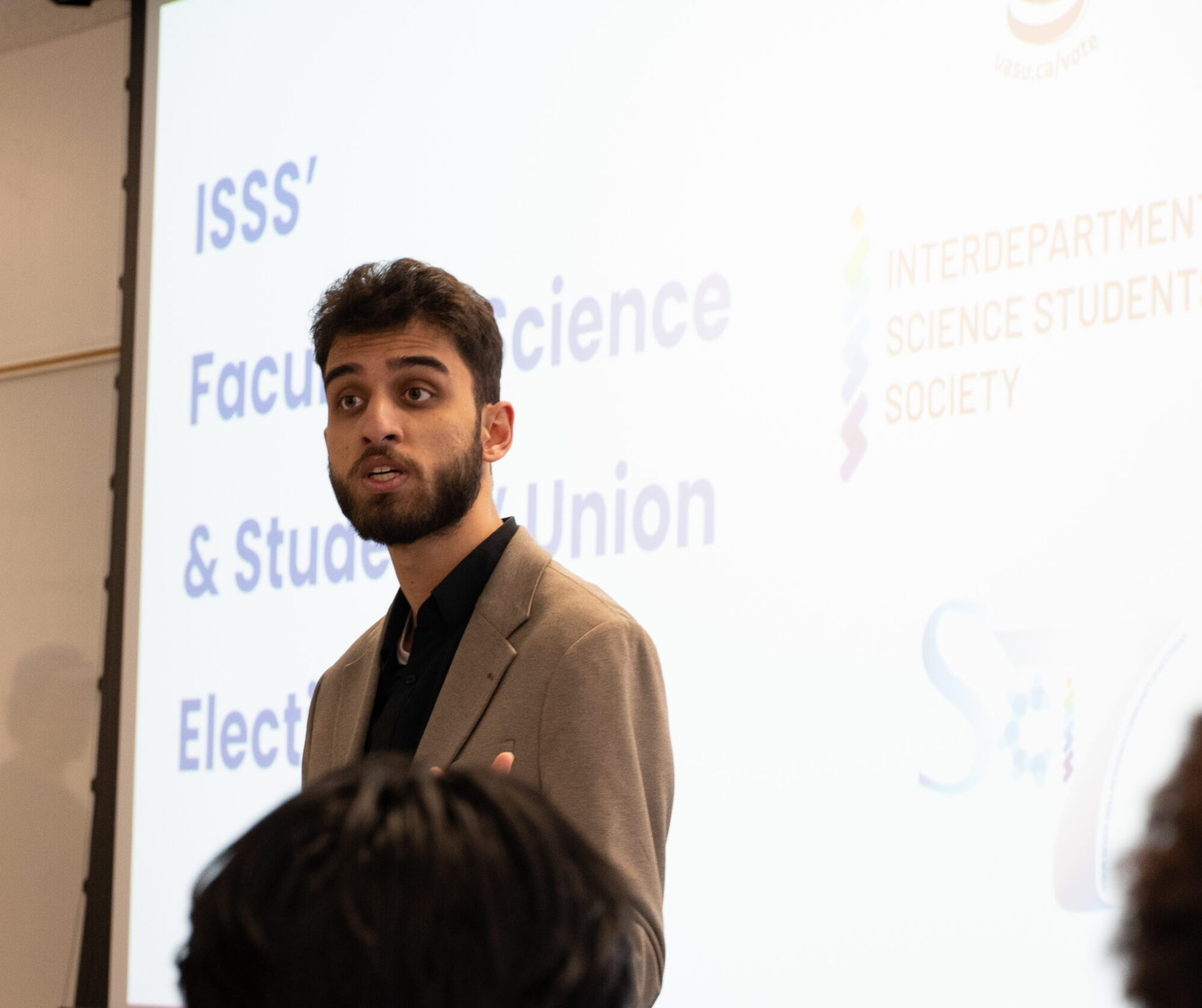
Abdul Abbasi said in his opening statement that “the SU needs to keep pushing for the big things that matter to students, whether that’s affordability or transit safety, but also the small things that shape everyday experience, like the microwaves in [the Central Academic Building] (CAB), water fountains, portable chargers.”
He mentioned working with the VPA to make both general and faculty advising better for students. Abbasi also said he would push the provincial government to implement the Mintz Panel recommendations.
The moderator asked what specific action he would take as president to expand accessible work-integrated learning (WIL) opportunities for science students and how he would strengthen external partnerships to support WIL.
“We have been able to see 55,000 seats across the country from the federal goverment through the student work placement program and 2,500 seats provincially when it comes to [WIL],” he said, referring to his achievements as VPX.
He emphasized making sure science students are getting funding from the provincial government, as well as pushing within the university to expand those opportunities.
Naveed’s second question was how Abbasi would strengthen funding pathways for undergraduate research.
Abbasi reiterated advocating to provincial, federal, and university partners to expand undergraduate research opportunities. He also said that the U of A is seeing an increasing operating grant from the province. The operating grant for the U of A has risen by $13.1 million to a total of $449 million in both 2025–26 and 2026–27.
VPX candidates discuss more co-op and research for students
In her opening statement, Arman Chauhan said she would address the daily pressures science students face, starting with safety and finances. Additionally, she discussed expanding the leisure access program, pushing for more open access resources to reduce textbook costs, and advocating for more non-repayable student grants.
Angel Raina said she’s heard a lot of concerns about research and job availability for science students.
“Pushing for more co-ordintion and allocation of research funds” through federal research bodies “should open up more seats for undergraduate research as well,” Raina said.
On the municipal level, she said she would support the Edmonton Student Alliance’s recommendation to add another granting stream for local businesses.
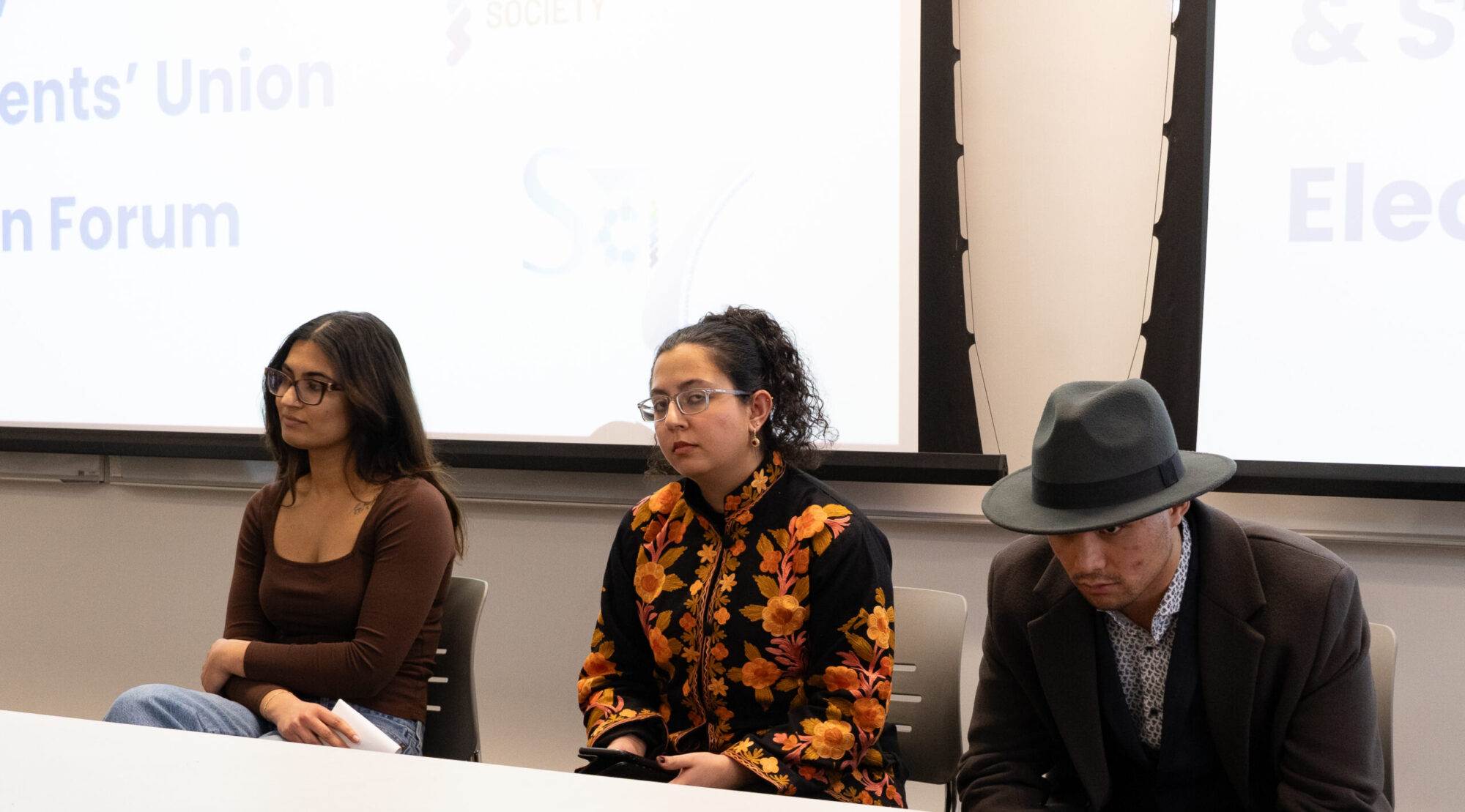
Dustin Rodenbush said he would look to expand university internship and co-op programs by meeting with businesses, companies, and corporations to encourage them to hire students.
“I will look to make the transition from education to work smoother, with a focus on getting students in jobs relating to the fields they actually studied in,” he added.
He reiterated his goal to push back on any cuts to federal student grants ahead of the next federal budget.
Naveed’s question to the candidates was how would they advocate to make sure government funding translates into meaningful improvements to the science student experience.
Chauhan said that the City of Edmonton is pushing for student partnerships. Additionally, pushing the Mintz Panel recommendation of a grants-first model and to prioritize grants over loans for students.
“The federal government is spending a lot of money towards work placement programs, I’m not sure how feasible it is expanding the Canada summer jobs program,” Chauhan said. Instead she’d push for the expansion of the Canada Student Grant to $5,000.
Raina said that she’d advocate for more a collaborative model between public institutions and the province as they rework how they are funded.
“So making sure capital infastructure funding is a separate category and it’s not coming out of operating grants, really pushing to look at deferred maintenance,” she said.
Raina added that there are opportunities with non-government organizations and private organizations to support students.
Rodenbush reiterated avoiding a cut to the federal grants, as well as making sure “the student body [has] a seat at the table whenever the university does talk to the government … to actually get a say on where funding goes.”
VPOF candidates talk about support for groups and students
Armaan Singh stated the four pillars of his platform: financial transparency, generating more non-student revenue, food insecurity, and anonymous sexual assault reporting.
Logan West, the current SU VPSL, said she hopes to expand access and support for student groups, specifically when it comes to grants. Additionally, she’d lead a large-scale review of event approvals and regulation processes.
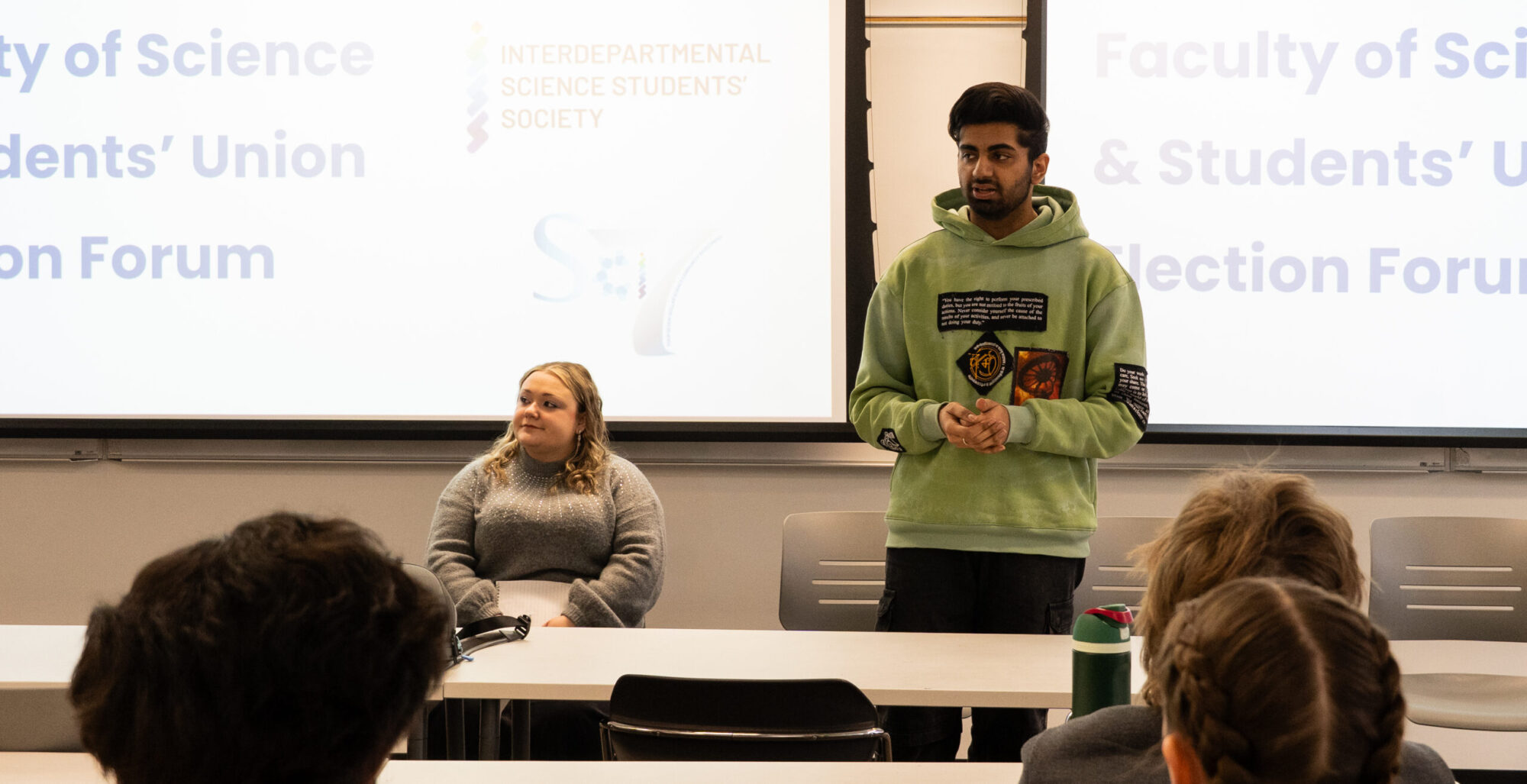
West added that she would like to have “a student talent hub where students can advertise photography, videography, their music, etc., so they can make money through their side hustles.”
Naveed asked how candidates would balance long-term planning with addressing immediate operation needs.
Singh said he would work to make sure supports available to students extend to the faculty of science and are well advertised.
West said she’d focus on making sure there are three-year operational plans developed for all SU departments. This would help expand student hiring, diversifying the SU’s revenue, and improving communications.
VPA candidate would push for improved advising
Susan Huseynova, the only candidate running in the VPA race, referenced her experience as VPA for ISSS.
“I definitely understand a specific kind of chaos that science students deal with, between the packed course sequences and the labs that take over your week, and the pre-requisites that don’t always line up the way they should,” she said.
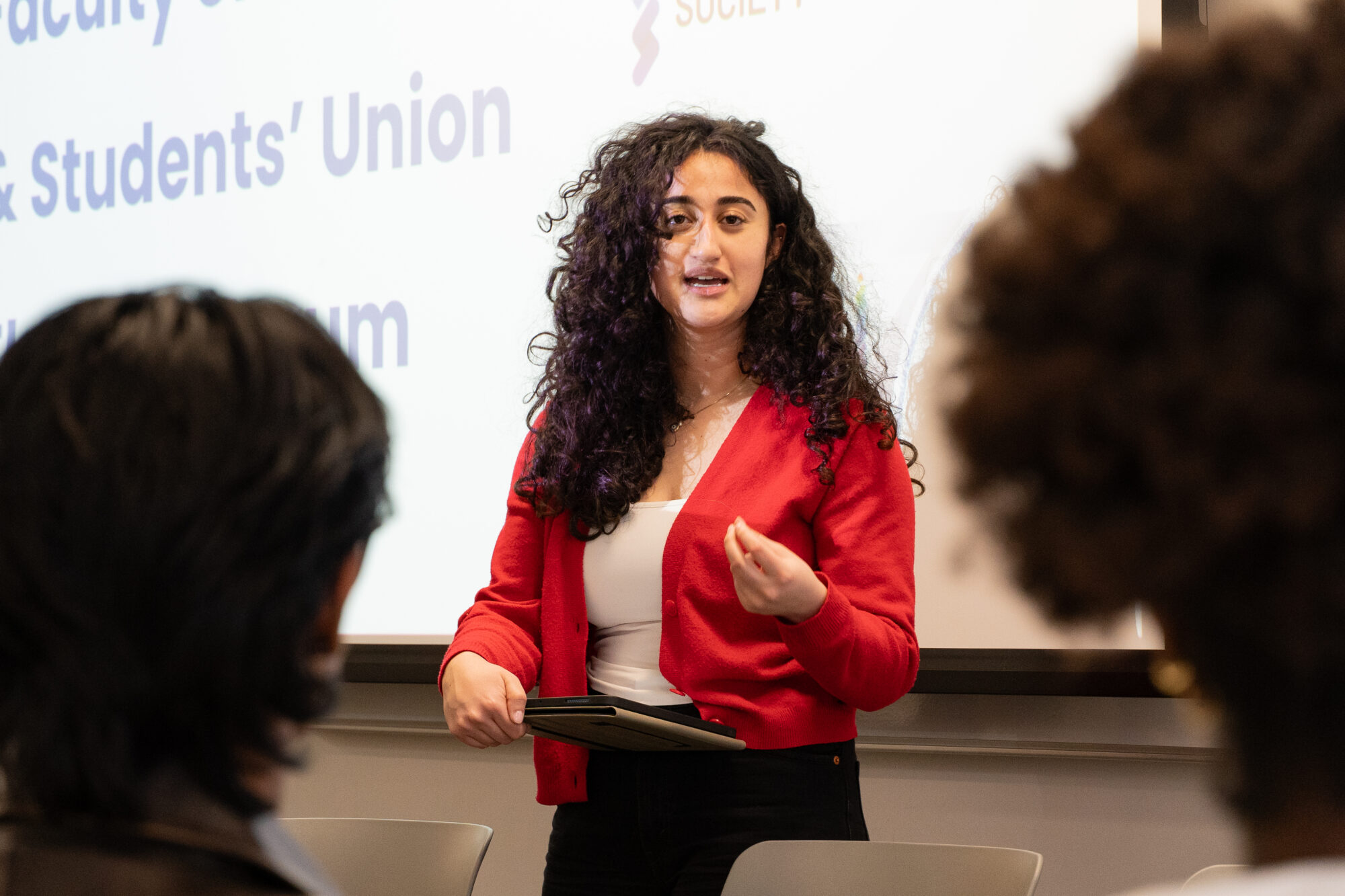
Huseynova added there’s low satisfaction with science advising and limited research opportunities in the faculty.
She said she would directly confront these issues and build on the ongoing advising work being done.
“What that looks like is pushing for better service and clearer information students can actually trust and smoother pathways to the supports and the opportunities the science students rely on.”
Naveed asked what concrete steps Huseynova would take to advocate for improvement in accessibility, timeliness, and respect for science students.
“The plan is to push for a more co-ordinated and more centralized advising system that keeps the faculty expertise where it’s needed,” she said. “Doing that, you can also have students triage their issues so they can have the main issues solved through the centralized system, with the more specific faculty or departmental level stuff sent to the proper place.”
VPSL candidates discuss community, events, and accessibility
Brish Goorimoorthee proposed an catered career and research fair for science students.
Nolan Greenwood repeated his platform of improving residence, implementing the 11 Sexual and Gender-Based Violence (SGBV) task force recommendations, and supporting student groups.
Manyu Rathour said that “building community through [the Council of Student Assocations] (COSA) and raising awareness and surveying” are some of his priorities.
He also formally endorsed the ISSS faculty association membership fee (FAMF). Rathour mentioned safety, destandardizing residence, stopping tuition hikes, mental health supports, and promoting access to student jobs.
Paige Wall said “student life is not about creating more events, it’s about supporting the systems that already exist and making sure they’re resourced properly.”
She emphasized accessibility and affordability as key focuses of her campaign.
Naveed’s question to the candidates was how they would meet the advocacy and wellness needs of science students who spend most of their time in their faculty spaces.
Goorimoorthee proposed bringing more events into science buildings that are low pressure, low commitment.
Greenwood said “this comes down to simple communication between myself, student groups like ISSS” to better understand what science students want.
“One thing I personally wouldn’t do is not host [events] at 2:00 p.m. when labs are starting,” Rathour said.
The ISSS forum began at 2:00 p.m..
Rathour said he would work with COFA to support groups like ISSS.
BoG representative candidate Tala Mojarrad emphasizes connection
No BoG representative candidates were able to attend, but Tala Mojarrad’s campaign manager, Ethel Oguntoye, gave statements and answered a question on her behalf.
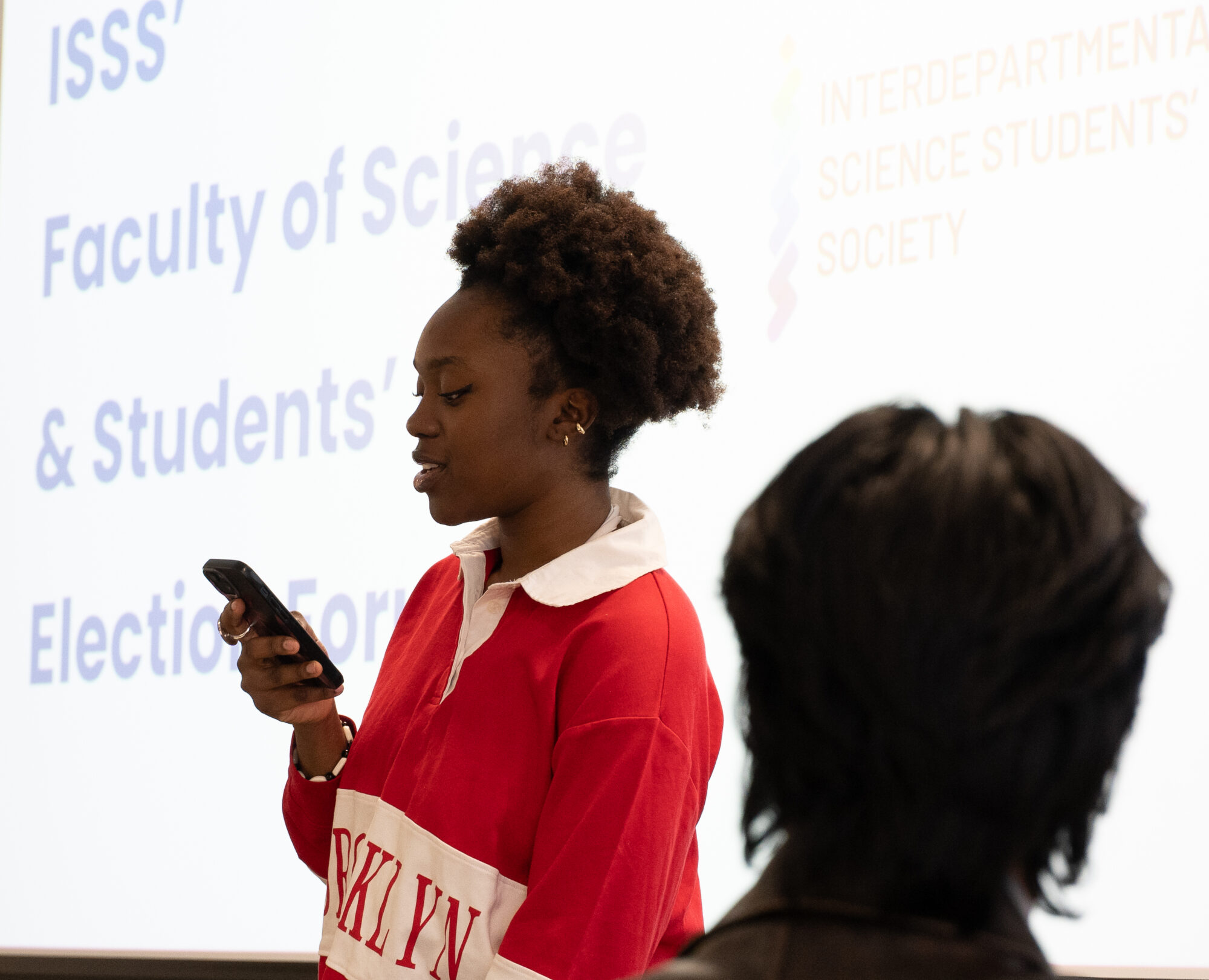
“Relationship and connection matters … that is precisely how I can improve accessibility to resources, develop a documentation platform, and educatively advocate for your voice on [BoG],” she said.
Mojarrad would make sure resources like the Campus Food Bank is accessible, as well as opportunities like undergraduate research.
Naveed asked how she would get more equitable and meaningful research and experimental learning opportunities.
“I’ve noticed information about co-op and research opportunities can go scattered,” Oguntoye said. “I can’t run these programs, but I can advocate for clearer institutional communication and reporting on experiential learning access.”
Documentation of students’ experiences would inform Mojarrad’s advocacy to the board.
Plebiscites discuss fees for renewal
Daniel Gutierrez attended the forum on behalf of the Green and Gold Fund plebiscite. The plebiscite is seeking a renewal of a $5.11 each semester.
Gutierrez said the costs associated with varsity athletes and teams are funded by the Green and Gold Fund.
“But quite a bit of [the fund] goes to support the greater student body … [we] create lots of opportunities to drive students.”
Gutierrez said that third parties that also match the funding. The fee is able to support initiatives like equity, diversity, and inclusion (EDI) and coaching initiatives.
ISSS is also running to renew its fee, with an increase from $5 to $7 per semester. Christene Saji represented the ISSS at the forum.
“It’s meant to support professional development opportunities, and it’s meant to support opportunities in terms of your academics and community,” she said.
She said the fee has been the same for 14 years, and with inflation an increase is necessary to increase their initiatives. The increased fee would allow ISSS to increase its student scholarships by $2,000. It would also support funding for national or international travel for professional development opportunities.