U of A president’s expenses higher than previous president and other institutions
President and Vice-chancellor Bill Flanagan spent $506,901.01 on travel and hospitality in his first term.

 Leah Hennig
University of Alberta President and Vice-chancellor Bill Flanagan’s expenses exceed those of comparable universities. In his first term as president, Flanagan spent over half a million dollars on travel and hospitality.
The U of A publicly releases the expense reports of its executives every quarter. The expenses can include the costs of travel, hospitality, and working sessions for university business. These expenses are reimbursed to executives after an approval process.
The president “provides the university with strategic leadership, oversees the university’s operational and change management processes, represents and upholds academic credibility, [and] leads the university’s external relations locally, nationally, and internationally,” according to the U of A’s website.
U of A media relations told The Gateway in a statement that “travelling, both domestically and internationally, is a routine part of the president’s job.”
Media relations also stated that the president’s travel “builds and strengthens connections with governments, post-secondary institutions, and industry partners across Canada and around the world.”
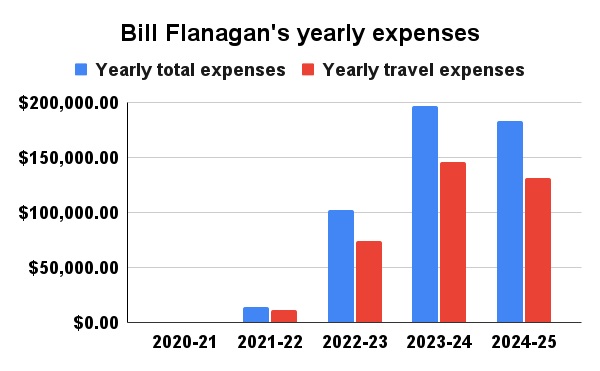
Flanagan has been president and vice-chancellor of the U of A since July 2020. From July 2020 to June 30, 2021, Flanagan incurred no travel expenses. This was during the height of the COVID-19 pandemic.
But from July 1, 2021 to March 31, 2025, Flanagan has spent $506,901.01 on travel and hospitality. Travel costs make up, on average, almost three quarters of the total expenses.
Flanagan has made a total of 124 trips in this period, with 37 of those being international trips and the rest being domestic travel. The most common purpose for travel listed is meetings with partners or external organizations. This often includes the U15 and other organizations of post-secondary institutions.
Other common reasons for travel are for summits, forums, or conferences; government meetings; alumni and donor meetings and events; and other events such visits to research centres or other campuses.
U of A President’s travel and hospitality expenses have increased significantly
The president’s expenses have more than doubled since Flanagan took office. The public disclosures only show two years of David Turpin’s time as president before Flanagan took on the role. Two quarters of Turpin’s term was during the COVID-19 pandemic, which limited travel.
But when compared to Flanagan’s expenses in the same period of time, the president’s expenses have increased by 294 per cent.
Disclosure rules vary across different provinces, but The Gateway compared Flanagan’s expenses with some other Canadian university presidents that publicly disclose the travel and hospitality expenses of their presidents.
In the 2024–25 fiscal year, the University of Victoria’s president spent $56,003.53. The University of Calgary’s president spent $65,744.33. The University of Toronto’s president spent $92,351.75. Flanagan spent $190,403.08 in the same period.
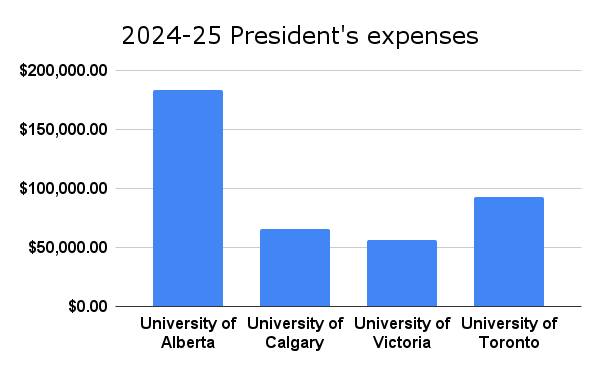
Flanagan’s expenses exceeded the total expenses for all University of Manitoba executives, which came out to a total of $193,009.49 in 2023–24. The president of the U of M spent $37,563.13. Flanagan’s expenses totalled $199,414.60 in the same period.
In the 2024–25 fiscal year, all of the U of A vice-presidents’ and president’s expenses added up to $271,669.32. Flanagan spent $190,403.08, accounting for 67 per cent of the total expenses.
Documents show final cost of trip far exceeded approved estimates
In February 15 to 23, 2025, Flanagan and his spouse, Saffron Sri, took a trip to Palm Springs and Phoenix. The trip was for the purpose of alumni and donor meetings. Flanagan had a total of four meetings and held one breakfast event with an estimated 50 attendees.
Documents obtained through an Access to Information request and shared with The Gateway show that the expenses far exceeded what the approved estimate was.
Travel to the United States and internationally must be approved by the chair of the Board of Governors ahead of time.
U of A media relations noted that this adheres to the Government of Alberta’s Travel, Meal and Hospitality Policy. The policy is a framework to guide for oversight of reimbursement for travel and hospitality expenses for government business with public resources.
The chair approved the trip with an total estimated cost of $3,601.30. The final total marked for the U of A reimbursed Flanagan for was $6,606.63.
Receipts show that ground transportation, which included gas, car rentals, and Ubers, came to a total of $428.93. The original estimate for ground transportation was $250.
Total hotels costs twice the estimate
Additionally, hotel costs were more than double the estimated $1,250. Receipts show that hotel costs added up to $2,785.77.
The first hotel, in Palm Springs, cost $350.81 a night. Flanagan and his husband spent six days at the hotel, but the first three nights were vacation and paid by the couple personally. The university only paid for the three other nights, and covered the total taxes and fees for the entire stay. The total for reimbursement was $1,804.45 for three nights.
In Phoenix, the second hotel cost about $261.58 per night. For a total of three nights, including fees and taxes, it came to a total of $981.32.
The U of A’s travel processes and expenses policy states that “only the cost of the most effective and economical mode of travel will be reimbursed.”
Expenses that are more costly require an explanation as to why it is necessary.
U of A media relations told The Gateway that mid-range hotels in Palm Springs cost about $250–400 per night in February. Mid-range hotels in Phoenix cost about $325–550 per night, according to the U of A.
According to online hotel booking sites, a four-star hotel in Phoenix or Palm Springs in February could cost between $200 to upwards of $1,000 per night.
Media relations also said in a statement that “engagement with alumni, both domestically and internationally, is a vital part of university fundraising and stewarding relationships. In the past year, donors gave $172.9 million to the university, supporting research, student learning, student supports, and university facilities.”
Flanagan was not available for an interview.
With files from Charles Rusnell