Book Review: ‘Frank Farley and the Birds of Alberta’
New book about Frank Farley expresses the importance of human connection.

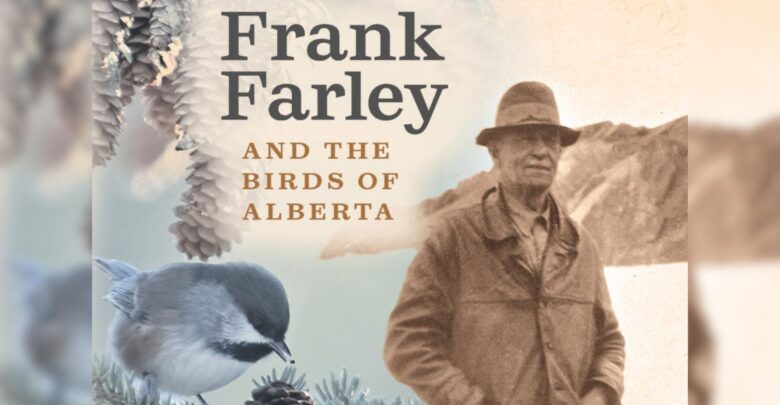 Supplied
While Glen Hvenegaard, Jeremy Mouat, and Heather J. Marshall’s new book Frank Farley and the Birds of Alberta is a treasure trove of ornithology and Canadian history interwoven into a biography, its real focus is the potential of humanity when we support one another.
Through infusing an interdisciplinary approach to the biographical genre, the literature presents Frank Farley, an individual with many titles. He was an author, educator, historian, volunteer, and as the title would suggest, an ornithologist. Wholly, someone who dedicated much of their life to the study of birds.
Ornithology fans would certainly find the work informative and enriching. But the interwoven elements of Canadian history, particularly of Western Canada, creates a broad and diverse appeal. Revolving around Farley’s work in matters of conservation and ornithology, I found great enjoyment in the literature’s delving into the authenticity of human life and the lasting impact relationships can have on our lives.
While Farley is known for his time in Alberta, the first chapter informs the reader of his birthplace in St. Thomas, Ontario, along with the genesis of how he became who we know today. From a young age, Farley was interested in birds and ornithology. This interest was supported and fostered by his parents.
As we learn early in the book, his mother provided reading materials and resources related to his interest in birds. His father would take him on hunting trips to apply this growing interest.
With the foundation of this initial interest, Farley, through the guidance of his older friend, Will E. Saunders, began to take notes on bird sightings. Just as the Saunders’ were prominent in the world of ornithology at the time, so were the McIlwraiths. Particularly Thomas McIlwraith, who was one of the leading ornithologists in Canada at the time.
Introduced as a part of Farley’s diary, the McIlwraiths were quite familiar with Farley. He documented his bird observation trip with Ken McIlwraith, the youngest son of Thomas McIlwraith, in his diary. Around the same time, Farley’s career in ornithology had truly begun and he started publishing on his documented bird sightings. Farley’s path into ornithology and nature had been one of patience, and lifelong learning from both people and his environment.
As we see his story unravel throughout the chapters, Farley’s deep knowledge is shown to be the fruit of his longstanding relationships as much as his independent study and interest.
The second chapter discusses Farley’s time in Camrose, where he became well-known for his work in ornithology. The foundational component set out in the first chapter of Farley’s beginnings ties together the entire book. The importance of relationships is set, not as a backdrop, but as a decisive factor in Farley’s devotion to the field of ornithology.
In the penultimate chapter, there is a glimpse into Farley’s influence on how ornithologists engaged with one another and wildlife matters broadly.
The importance of networking and of forming connections in the field of ornithology is discussed in relation to Farley’s own aforementioned life. As Farley had befriended Thomas McIlwraith and Will E. Saunders in his early years, Farley, now as an experienced ornithologist in Alberta in the 1930s, had developed close-knit relationships with the next generation of ornithologists in the nation. In a field where information and research was crucial, Farley had fostered an environment of co-operativeness and mutual support through his actions.
In the last chapter, Farley’s mentorship is shown beyond the scope of his tutelage of other ornithologists. But rather through his aim to inspire and educate the children of Camrose. Many of Farley’s young mentees would go on to pursue careers of ornithology and related fields.
As the book reminds us, the tangible impact of Farley is not to be understated. However, the subtle string that runs concurrent to the biography itself is the cyclical nature of life and human connection. Notably, Farley passes on the way he was inspired, mentored, and taught, onto the next generation. In Frank Farley and the Birds of Alberta, the connectedness of the human spirit is the prevailing takeaway. The book is a tremendous biography on one of the most impactful ornithologists in Western Canadian history.