
 Leah Hennig
 If Campus Saint-Jean (CSJ) wanted a party planner, it would have elected one years ago. Instead, at the CSJ forum, what hung in the air wasn’t confetti — it was parity.
The divide between Abdul Abbasi and Joseph Sesek was not about whether CSJ matters. Both candidates clearly believe it does. The difference lies in how they think change happens — and whether their proposals match the scale of CSJ’s frustrations.
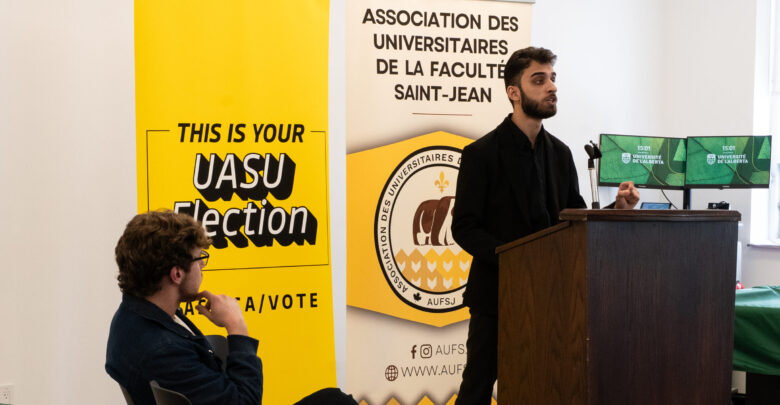
Abbasi approached the forum with the posture of an institutional insider. He described CSJ as a proud francophone community that deserves consistent advocacy at the Board of Governors and different levels of government. His pitch centred on continuity: maintain strong communication, protect l’Association des Universitaires de la Faculté Saint-Jean’s (AUFSJ) autonomy, and keep pushing externally for funding and attention. He emphasized that relationships and credibility matter when navigating university bureaucracy.
One of his more concrete proposals — expanding French translation across the university’s website and systems — directly reflects CSJ’s identity. That initiative may not generate applause, but it would materially improve access for francophone and international students. It embeds CSJ’s linguistic reality into the university’s infrastructure rather than treating it as an add-on. Abbasi’s strategy feels incremental, but it also feels grounded in how university governance actually works.
But this isn’t new. Candidates consistently promise more translated resources, but little progress is made each year. For Abbasi, the proof will be in the pudding.
Sesek, by contrast, framed CSJ as underrepresented and underserved. His tone carried urgency. He highlighted reduced library hours, residence maintenance delays, and rising meal plan costs. He explicitly pledged to restore weekend access to Bibliothèque Saint-Jean and review rent rationalization policies that leave students paying higher prices for what many perceive as mid-tier service.
That clarity deserves credit. Restoring library hours would have an immediate and tangible impact. For residents who rely on that space as their primary study environment, access is not symbolic. It is functional. Reviewing residence costs and maintenance standards also addresses daily quality-of-life concerns. Even if those goals are ambitious, they at least align directly with the problems CSJ students experience.
Where Sesek’s platform faltered was in scale and focus — most notably with his proposal to organize a Mardi Gras celebration to unify campuses and raise CSJ’s visibility.
On its own, a Mardi Gras event is not objectionable. It celebrates francophone culture. It could foster cross-campus engagement. Community-building has value. But placed alongside structural grievances about access and equity, the proposal felt miscalibrated.
CSJ’s core issue is not that North Campus students have never heard of it. The issue is that decision-making structures repeatedly fail to prioritize it. A themed celebration does not restore 10 hours of weekend library access. It does not renegotiate ancillary budgets. It does not fix maintenance timelines. It risks reframing marginalization as a marketing problem rather than a governance one.
The danger is subtle but real. When structural inequities are answered with visibility campaigns, the underlying imbalance remains intact. CSJ does not lack personality. It lacks proportional influence.
Sesek’s platform does address some of these issues. His willingness to name inequities directly sets him apart. He did not sugarcoat the disparity in services. He treated parity as a right, not a favour. That framing resonates, especially at a campus that often feels peripheral.
However, bold rhetoric demands equally bold planning. Restoring library hours requires negotiations with administration and possibly budget reallocations. Reviewing rent rationalization involves understanding complex financial structures. Creating a Mardi Gras event is logistically simpler. That imbalance risks undermining the seriousness of his structural promises.
Abbasi’s approach lacks dramatic flair, but it avoids that mismatch. His emphasis on sustained advocacy and translation initiatives may feel procedural, yet it situates CSJ’s concerns within institutional processes. He appears to view change as cumulative rather than theatrical. However, his campaign feels stuck in his current role as VPX and sometimes fails to show how he would adapt to a new role with new responsibilities.
The presidential race at CSJ ultimately exposed two theories of leadership. Sesek embodies urgency and confrontation. Abbasi embodies continuity and institutional leverage. Both recognize that CSJ deserves better. Only one consistently aligned proposal with structural outcomes.
Parity requires more than celebration. It requires negotiation, budget literacy, and long-term pressure on decision-makers. If Sesek can translate his urgency into that kind of strategic depth, his platform gains weight. If not, Mardi Gras risks becoming a metaphor for misplaced priorities.
CSJ does not need to be spotlighted for a weekend. It needs to be treated equally every day. The candidate who proves they understand that distinction — not just rhetorically, but operationally — will have earned more than applause.