SU Elections Q&A: Vice-president (student life)
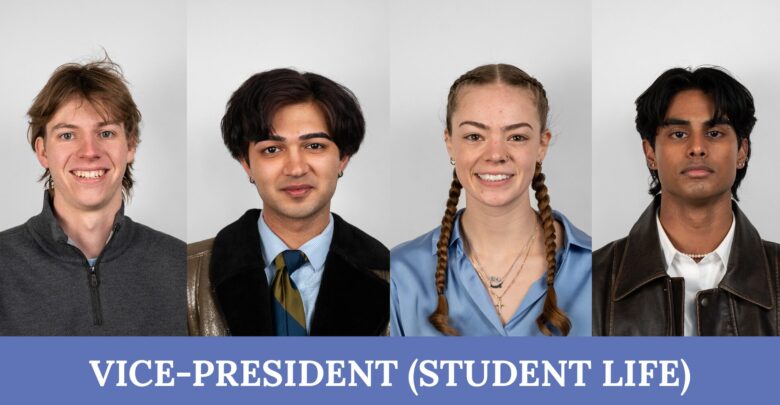
There are four candidates in the 2026 Students' Union vice-president (student life) race: Brish Goorimoorthee, Nolan Greenwood, Manyu Rathour, and Paige Wall.

 Leah Hennig
 The Students’ Union (SU) vice-president (student life) (VPSL) is responsible for non-academic advocacy regarding issues that impact students. The wide range of responsibilities of the VPSL can include mental health and well-being supports, advocacy for those living in residence, and more. The VPSL is also responsible for many programs and events completed by the SU.
These are the four candidates running in the VPSL race:
- Brish Goorimoorthee, a third-year media studies student
- Nolan Greenwood, a fourth-year business economics and law student and 2025-26 president of the Lister Hall Student Association (LHSA)
- Manyu Rathour, a second-year computing science student and 2025-26 wellness ambassador for Lister Residence
- Paige Wall, a third-year kinesiology, sport, and recreation (KSR) student and 2025-26 KSR councillor on the Students’ Union Council
The following interviews have been edited for brevity and clarity. Candidates were given 1 minute and 30 seconds to answer each question.
Why have you decided to run for VPSL?
Brish Goorimoorthee: The reason I ran for VPSL is because I’ve been heavily involved around campus since my first year. I joined the U of A in 2023 and immediately joined the Visual Arts and Student Association (VASA). Then I switched majors, and that was a whole thing. But essentially, every single year, I was part of something, and I really like the community and friends I made along the way. So I was like, “I’m meeting so many students, and I have such a connection with them, I might as well represent them in the best way I can.” I know there are a lot of issues, a lot of work that we can do on campus to be more involved and advocate for [students], right? So, I just want to represent them the best I [can]. I know we have a lot of issues with safety. In my personal experience, the amount of times I probably had to call campus security, issues with accessibility [and] accommodations, getting into HUB, the prayer rooms, and even the art studios where classes are. This is not a place students should be, and things have to change for a better quality of life, even [in residence]. A lot of residents suffer increased rent, increased payments for lower quality.
Nolan Greenwood: I think the VPSL portfolio is one that’s always been of interest to me. Obviously, with my previous role within residence, [this position is] obviously the most transferable to my role. I’ve enjoyed student advocacy within residence, seeing the changes I can make over my couple of years as president of the LHSA, I think it’s something I want to apply to a larger, broader scale on campus. VPSL seems like the next step forward. It’s a role, I think, that I can make a lot of good change in. Not that the role has been done bad previously, but it seems like the best vessel for me to continue my advocacy. [It is] something I’ve really enjoyed, and being able to make changes and see changes that I want to see made continue from residence to the greater campus.
Manyu Rathour: When I first lost my election, when I ran in my first year for vice-president (academic), I really thought about what I’m doing in terms [of] the university, and what I thought my purpose was. A lot of it came back to student well-being, and the overall happiness of the students, and I think the VPSL most resonates with that role. Another contributing factor was that I thought that in the current term that I was able to fully witness a governance year. I thought that there was much more work that could have been done with the VPSL portfolio. As someone who was on the [sexual and gender-based violence] (SGBV) task force representing the international students, I thought that, in a full time position, there should be a VPSL that could satisfy everyone’s needs, while ensuring that our entire campus succeeds, and I think that we can have more than one march in one year.
Paige Wall: Over the last few years, since I’ve been in this school, I’ve talked to a lot of students. I’ve listened, I’ve seen, and I’ve understood some of the gaps that students are facing in their student life. I care about a lot of fairness and accountability, so I thought that I could make a difference. That’s why I decided to run.
What would you say are the three main takeaways from your platform?
Goorimoorthee: I wanted to emphasize student groups. As someone who has been part of the Week of Welcome, too many student groups to count, and just gone to a lot of community events for the sake of just meeting new people, I think our biggest strength as a student population is our student groups. So, advocating for them and meeting their needs, even the big [ones like] the Organization for Arts Students and Interdisciplinary Studies (OASIS), the Undergraduate Science Students’ Faculty Association (ISSS), [and the] International Student Association (ISA). Also, continuing a lot of the initiatives made by the previous VPSLs and executives. [The] SGBV awareness was great. Pedway access [was] amazing. Safewalk, amazing. Continuing those initiatives, as well pushing for more student-led initiatives, [by] giving support to individual students to make changes. For example, a few months ago I was trying to start an event on my own, without a student group, and it was very difficult to do. Allowing that accessibility and inclusion to be able to make events without money being an issue or rentals or venues, and just creating that campus culture [with a] big focus on bringing student spirits and building our campus culture to be as great as it could be.
Greenwood: I think the first for me is residence. Obviously, there’s been a ton of stuff going on with residence recently, I have a ton of stuff planned for that, including continuing the work that we’ve been doing on Council of Residence Association (CORA), the [residence] town hall. I’m hoping to see some of the changes that we brought up, and a little more clarity on some of the things that we are facing within residence. Secondly, the SGBV work done over the past year. I want to continue that. I think it’s a great initiative, and we’ve done a ton of work, having been on the SGBV task force myself. But now it turns over into implementing some of the recommendations and actually seeing those changes made, rather than just being put on paper. Finally, I think the biggest thing through my consultations is transparency and communication from the role. This is less of a platform point, but something I would like to see from the role, continuous communication between the VPSL and student leaders is something I want to do well on. Not only consulting now during the campaigning, but also through the year to know what issues come up and need to be addressed, rather than just the ones that I was faced with from basically a year ago.
Rathour: My platform also revolves around the student well-being and their wellnesses. Four mainly that I think of, and a special topic for residence, financial wellness, which is a lot of students have expressed that, I think it was 27 per cent that try to look for jobs, but can’t find any, or face rejections, and end up unemployed. I think that it is drastically bringing down the happiness level of our campus, considering that 27 per cent of 40,000 is a very big number. I also wanted to focus on creating work-integrated learning with land-based teachings being included. There’s been issues on campus where many of the positions that have the requirement of Indigenous students often don’t get filled up because of the lack of communication that exists between different areas of the university. Let’s say residence has an Indigenous cohort leader, almost every year, that position goes unfilled, even though it’s a paid position, and many student leaders, much like have been expressed by the Indigenous Students’ Union (ISU), are looking for jobs that are Indigenous-friendly, and are looking for jobs that also are not just volunteer positions because most of them that get offered to students often are.
Wall: My four are: I fair and accountable campus life, transparent advocacy for students, stronger student group support, along with accessible supports and basic needs for students. For fair and accountable campus life, I want clear student-facing reviews and better follow-up from things like maintenance and residence. For transparent advocacy, I want advocacy not behind closed doors. I want plain language used and progress seen by students. For stronger student group support, there’s a lot of heavy lifting that student groups do, but there are unclear policies and a lot of sudden changes that student groups experience, so a bit more communication between the student group services and student groups themselves. For accessible supports and basic needs, short-term illness and random challenges that students face can snowball very quickly, so I want to make sure that there’s better communication about existing supports and work with campus partners to figure out what we can do better for students.
Students have raised several concerns about the state of residence. How would you work with Residence Services to address these concerns?
Goorimoorthee: So actually, I did read the recent article about it, and I was talking about the rent rationalization, which was a big thing that I recently learned about. For less quality, paying more than some of the other residents is a big issue, in my opinion. Dealing with mold, utilities not working, elevators not working, and concerns not being heard, and having to pay more without seeing any changes, is just not something I want to see, right? Of course, we have the East Campus [Students’] Association, and like the LHSA and all those big groups [that] are trying to make a change. So supporting them as much as I can. They know their residents better than I do, help them in any way I can. Also, pushing for that campus culture that they have onto our main campus.
Greenwood: Obviously, from my past experience, I have a ton of work working with Residence Services on issues, albeit I will say smaller scale, addressing, obviously, just Lister rather than all residences on campus. I’ve worked with everyone in Residence Services, which means I really feel I have the knowledge of who to go to for certain issues that need to be addressed, because it’s not all just a one-size-fits-all solution for Residence Services. One thing that I found with working with Residence Services is they’re very set in their ways, and getting them to change is a very difficult thing. In order to do it well though, they must see what the advantage of changing is, and that needs to be something that’s presented very clearly to them, and that’s something I would hope to do. I think ensuring that there’s transparency from Residence Services to students, especially at a higher level, is something that is currently a big struggle. I think a lot of these decisions get made, such as rent rationalization, without proper consultation, and now we’re in the situation where we’re calling for a town hall and we are the ones saying like, “look, we want better consultation,” and we’re now calling for the change, but I think pre-rent rationalization, there just wasn’t a ton of work done in the consulting that could have been avoided if these larger scale issues had been better consulted at the beginning. So really encouraging student consultation before these bigger issues get made and transparency so people know what’s going on.
Rathour: I was Resident Assistant (RA) this year and also a wellness ambassador for Lister Hall, and residence has been a very important topic for me. The five-day meal plan was removed last year, which I think there’s a complete money grab happening there, and I think that I want to advocate for a better surveying system that could actually identify the student dissatisfaction that exists with the meal plan in itself, and the removal of the five-day meal plan. I also want to de-standardize the rent. I want to work with the city to run a fair market evaluation around the cost of rent around the university, and with the living conditions of each different residences, and make sure that students pay for what they are getting. I want to work in long-term advocacy for changing that. I would also like to change the way training is done for the RAs across different campuses because the Augustana residences don’t get the same training as East Campus RAs or Résidence Saint-Jean (RSJ) and Lister does. I also wanna make sure that there’s enough work that the SU is doing with residence associations.
Wall: I would work with Residence Services. I would try to do a lot of relationship building, have some structured consultations with the student groups surrounding residences and other supports that residents need. Along with a lot more public accountability mechanisms, so ways that students can see what’s being done, how it’s being done, and how it’s affecting them. And just a lot more accountability and communication about what students don’t see that’s actually happening that affects them.
The SGBV task force recently released its report. How would you work towards implementing the recommendations outlined in that report?
Goorimoorthee: I think one of the big aspects was the [Take Back the Night march] they did recently. So promoting that education. Until recently, even I wasn’t aware of everything that was happening on campus. So working alongside social media and other platforms to bring awareness. Then, continuing some of the initiatives that came from that. I think ONEcard access and Safewalk were among the big contributors to that. So continuing those initiatives and perfecting them and making them better and more accessible for students. Definitely opening on ONEcards, I’ve seen in my personal experience — I stay on campus very late, it can be a very dangerous place at times, especially on those late-night study sessions, so making sure it is safe and accessible for students. Then, of course, engaging with residents, senior RAs and floor co-ordinators, to promote initiatives and support for survivors and students who experience hardship in any way that we can.
Greenwood: Obviously, being a member of the report and on the task force, I’m very familiar. I think the biggest thing through which we’ll be able to implement the recommendations will be figuring out which campus partner works best for each of the recommendations and specifically targeting it to them. So, rather than just going to a general university and saying like, look, these are recommendations, but picking which recommendations work well with who. So, the U of A Sexual Assault Center (UASAC), for example, I think is a great resource to start working through some of the ones where proper collaboration can be done. I think they came during SGBV task force meetings and talked about some of the issues they were facing, so I think better accelerating them and helping them get started, better communication about what they do, the roles they can have for students is a big one. As we move on to the recommendations, for example, of the module, I think that really comes to working with the university to show them why it’s so important and how it’s being used for the module, for example, when it’s used at Western University, how the impact it’s had on like on SGBV on their campus and why it’s important that we implement it to the U of A campus. So, showing them the positive effects of some of the recommendations and why it’s important for the U of A to implement that.
Rathour: Some of those recommendations, I was very involved in planning out, and I would make sure that those concerns go to appropriate university administration, like the Dean of Students (DoS), the Board of Governors, and I want to initiate those conversations with those people, and make sure that the suggestions that are made are continued. I wanted to still keep the SGBV task force this year, but on a different task, on a different operating system, terms of reference, for it being different, where instead of suggestions, we make actionable changes like adding coursework and things along that line.
Note: The DoS has been renamed the Student Success and Experience.
Wall: Logan [West] did a very good job this year with the task force itself and consulting many different people. I would continue the consultation. I would try to get the supports out there more for students, in ways that students can see. I feel a lot emails go out, but a lot of students don’t really read emails. So, other ways that information could be shared with students, more surveys. I feel like they’ve done very good getting student feedback and information. I think all of the points in the task force recommendations are very well put, and I’d follow them. [West] did a very good job this year.
How would you ensure equitable access across campuses to supports and services?
Goorimoorthee: To ensure proper access between campuses, obviously, the biggest issue, in my opinion, would be distance. It is hard to get to Augustana, Campus Saint-Jean (CSJ) is a little bit far away. I know we have the shuttle services, which I would love to collaborate with them to expand on that and create that inter-campus connection, because at the end of the day, we’re all one student body. We may be separated by distance, but we are one university, right? So bringing events and initiatives that would reinforce engagement. I know we have a large French population here, and being able to connect them to CSJ would be helpful. Then vice versa, also bringing them to here [North Campus]. Augustana, try to bring more students from us to their events. Collaboration between, I would say, the ISA and the ISU would also be very helpful, so that we can bring more of those students together. One goal of mine I would really want, is to be able to create large-scale events with low commitment for students to engage themselves with. So, I know we have big sports events, and the SU events department is doing amazing things, but there [are] barriers to these events [because of] distance, or even time, money, and commitment. So, being able to break down those barriers, make them accessible, and build that campus community.
Greenwood: I actually met with Miron [Nekhoroshkov] [president of the Augustana Students’ Association] earlier today, so this was something we talked about. Something that consistently got brought up was that a lot of places, I’m going to use UASAC for example, has an online resource, but a lot of students don’t necessarily know about it. So, first of all, letting students be more aware of things like online resources like UASAC has, so that if they’re not on North Campus and they can’t come into the centre and it’s inconvenient for them, there’s resources online to do that. I think ensuring between campuses, like I said, open communication between, for example, ASA president is a great resource representing residents of Augustana. So, ensuring that communication is there to understand the challenges that North Campus is facing and then also Augustana is facing as well as CSJ are facing, I think is critical so we all work as one and understand the challenges. Something I was talking about with [Nekhoroshkov] today is ONEcard access was great on North Campus, but Augustana faced challenges. They just got their fitness centre to have extended hours. However, their study space is still 24 hours with basically just an unlocked door. So challenges like that that I think kind of get under-addressed, I think ensuring that if we’re going to roll out one.
Rathour: Many of the DoS’ services are not translated into French, which I’ve heard from some of the residents living in CSJ is a struggle. They often find it harder to access resources. For Augustana, I want to make sure that all the resources are equitable. The Augustana Food Pantry definitely needs to be supported better in terms of options that they can receive and proper nutrition that they can also be getting. The Campus Food Bank should definitely have a shuttle for CSJ.
Wall: I would collaborate with academic leadership and other leadership around campus to see where there are gaps and solutions for student-facing issues. I’d work a lot on relationship building, consultation with lots of the student groups, checking in on every faculty and every student group as they’re all important and very involved with the SU. They do a lot of the heavy lifting for the university itself, which they don’t really get the credit for. So, I feel like finding ways to appreciate the student groups and the students themselves for what they actually do for the campus would be a very good way to find equitable access. I would continue groups like Stride, things that get different types of people into different positions that they usually wouldn’t be able to find or access.
CORRECTION: A correction was issued on February 24 at 1:30 p.m. to reflect that Paige Wall is in her third year, not her fourth.