UASU launches new pilot project to expand student ONEcard access
The University of Alberta Student Union (UASU), in collaboration with the university, presents the winter 2026 ONEcard access Project Pilot that will expand student access to major buildings and pedways.

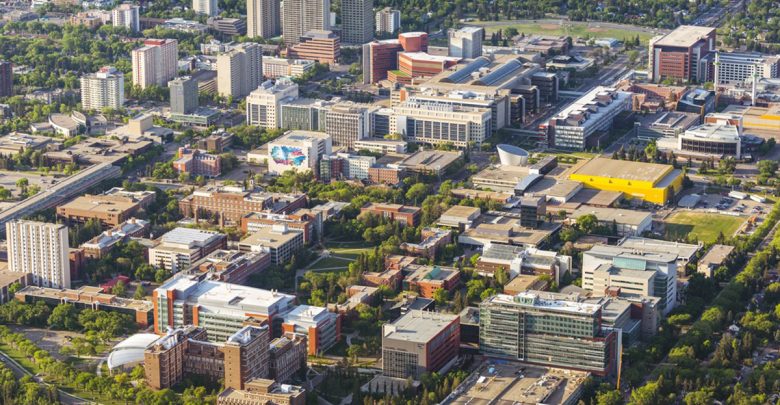 Supplied
On January 5, the University of Alberta Students’ Union (UASU), announced the new winter 2026 ONEcard Access Project Pilot. Developed in collaboration with the university, the project grants students expanded access to major buildings and pedways on North Campus.
According to UASU President Pedro Almeida, “the motivation [to start this project] was consistently hearing from students that traveling around campus, especially as we enter the colder and darker months of the year, was a barrier to having as good of a student experience as folks can have here.”
The UASU “engaged in a lot of discussion over what [extended access] could look like, reaffirming some of the access that [they] have previously gotten in 2023–24. Then, [they identified] how [they] could expand on that through this pilot project,” Almeida said.
As stated by Almeida, the U of A was supportive of this idea and throughly involved throughout the development process.
“I’m very thankful and grateful for the collaboration from President [Bill] Flanagan‘s office and the university services, operation and finance office, who have been great partners in coming up with the specific hours, the agreement for it, and everything moving forward,” Almeida said.
Routes and extended hours
The ONEcard Project will grant students extended access to five different routes, which include a variety of buildings and pedways.
The first runs from Tory Lecture Theatres through the Tory Building to the School of Business all the way to the Humanities Centre and HUB Mall. This will connect to the second that runs from Fine Arts Building to the Timms Centre for the Arts. These routes will have access extended to 10:15 p.m..
The second route runs from Biological Sciences Centre to the Centennial Centre for Interdisciplinary Science (CCIS) building. From there, the route extends to the east side of the Gunning/Lemieux Chemistry Centre, to the Central Academic Building (CAB), to the South Academic Building (SAB), and, lastly, to the University Commons.
This route will have extended access until 9:30 p.m. and Safewalk volunteers, who can open doors for students who present their ONEcard, patrolling from 9:30 p.m. to 10:30 p.m.. The access from CAB to UCommons will extent until 12:00 a.m. on weekdays and 9:30 p.m. on weekends.
The third runs from Donadeo Innovation Centre for Engineering (DICE) through the Chemical/Materials Engineering Building, to the Electrical and Computer Engineering Research Facility (ECERF), and the Engineering Teaching and Leaning Complex (ETLC). This route will also connect with the Mechanical Engineering (MEC) building, the Natural Resource Engineering Facility, the Agriculture/Forestry Centre and the Student Union Building (SUB). This route will have access extended until 9:30 p.m..
The last route runs from Education Centre through the pedways across 87th Avenue Northwest to the atrium in Heritage Medical Research Centre. From there the route connects to the Katz Group Centre for Pharmacy and Health Research and the Medical Sciences Building to the Dianne and Irving Kipnes Health Research Academy. This route will have extended access until 7:00 p.m., and Safewalk patrols from 7:00 p.m. to 10:30 p.m..
“It [is] our belief that providing greater access for students to travel between buildings helps to address safety and security concerns,” Almeida says
Despite the extended hours and less restricted access to buildings and pedways, Almeida stated that this system will reduce risk for students.
“It [is] our belief that providing greater access for students to travel between buildings helps to address safety and security concerns,” Almeida said.
As the new technology will only allow those who have a ONEcard to enter the university buildings during late hours, unaffiliated individuals will not have facilitated access to university facilities.
Accordingly, the new system will not provide access to specific sectioned-off research areas, so if an unaffiliated individual were to enter the university, they would not be able to access these spaces, Almeida stated.
The UASU and the university will be “looking very closely at the data … [and] how does this extra access compare with more calls to [the University of Alberta Protective Services], or more incidents of different things,” Almeida said.
“It’s a data collection timeline for us … to identify the areas where access should just be built into the building and headway systems, but also where investment should be prioritized for adding ONEcard readers and things of that nature,” Almeida added.