 Leah Hennig
If the International Students’ Association (ISA) presidential race were scored like a heavyweight title fight, this one would have required a referee and a standing eight-count.
The ISA forum on February 27 made one thing clear: this election is not about identifying problems. Rising tuition, housing strain, and campus safety concerns already define the reality for many international students. The real question is strategy. Should the University of Alberta Students’ Union (SU) president prioritize steady institutional leverage and incremental gains, or pursue sharper escalation and structural overhaul? That divide — more than any single policy — defines this race.
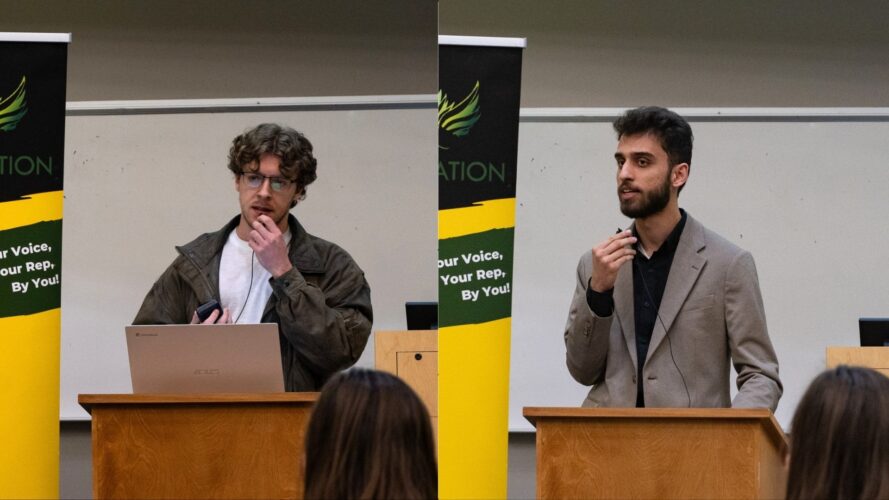
From the outset, Abbasi framed his campaign around transit safety, affordability, and mental health. He emphasized pushing the municipal government for mixed social worker and peace officer safety models. He committed to reviewing residence rent rationalization so international students receive value for their money. He underscored strengthening the Peer Support Centre (PSC). His message was consistent: he’ll use what worked in his role as VPX and apply those strategies as president.
Sesek framed his campaign around three problems: no one listens to international students, campus safety is inadequate, and residence management is unacceptable. He pledged to amend Bylaw 100 to give international students a permanent seat on Students’ Council. He promised additional lighting, CCTV cameras, expanded ONEcard access after hours, and a full overhaul of Residence Services, not just a review. He criticized the existence of empty beds alongside student homelessness. He promised visible action within one week of becoming president-elect. This, more than anything, seems overly ambitious.
The contrast is immediately clear. Abbasi talks like someone already inside the machine. Sesek talks like someone determined to break parts of it.
That contrast sharpened when advocacy escalation entered the conversation. When asked how they would respond if the university refused to freeze or reduce international tuition, Abbasi described a layered advocacy strategy. Public advocacy, he argued, remains a tool, but sustained lobbying and policy engagement form the backbone of effective pressure. He stressed alignment where possible and escalation where necessary. He also made a point that matters in governance: not every hill warrants relationship attrition.
Sesek offered a cleaner, but more vague, formula: listen, assess, negotiate, repeat. If necessary, act. The answer sounded decisive. It lacked operational detail. “Act” can mean many things. Mobilization requires coalition-building. Escalation demands planning. Confrontation without structure can backfire. The appeal of clarity does not replace the need for scaffolding.
In regards to safety, Sesek advocated expanded lighting, CCTV cameras, and broader ONEcard access to campus buildings after 6:00 p.m. and on weekends. He grounded this in personal experience living at St. Joseph’s College near the bus loop. He described assaults, harassment, and weapons on transit. His frustration felt real. When asked whom he had consulted about increased surveillance, he answered plainly: no one yet. He said he would drop two courses immediately, if elected, to prepare for the job full-time.
That honesty exposes a gap. Surveillance policies carry privacy implications. They affect all students, not only international students. Consultation matters in that context.
Abbasi challenged the surveillance emphasis directly. He framed safety through a mixed response model involving social workers and peace officers. His approach aligns with prevention and crisis response rather than monitoring expansion. It avoids some privacy concerns. It also depends on municipal co-operation and funding.
The sharpest clash of the night came over Abbasi’s record. Sesek framed the latest provincial budget as proof that advocacy had yielded little. Post-secondary education received a small operating increase that failed to keep pace with inflation. For students watching tuition climb, that gap feels personal. If funding does not outstrip rising costs, it is fair to ask what two years inside government rooms actually achieved.
Abbasi responded by untangling the numbers. He argued that widely cited student loan “cuts” largely reflect earlier eligibility changes that removed out-of-province private career college students from provincial loan calculations. In his view, the headline figure exaggerates the direct impact on U of A undergraduates.
However, according the Budget 2025, these changes were expected to save $117 million in student aid expenses over the next three years. Budget 2026 estimates a cut of $103 million in just one year. When taking enrolment growth targets into account, these cuts aren’t easily explained away.
More importantly, Abbasi pointed to a roughly $13.1 million operating grant increase and framed it as a structural gain. Operating grants anchor institutional budgets. They affect hiring capacity, program stability, and the degree to which universities rely on tuition revenue to fill gaps. An increase that falls short of inflation still shifts the baseline upward. Abbasi’s case rests on this premise: durable change in government funding rarely arrives in dramatic surges. It accumulates through sustained lobbying, repeated meetings, and incremental recalibration of provincial priorities.
Whether that accumulation feels meaningful depends on perspective. For students facing immediate financial strain, incremental progress can feel distant and frustrating. For those focused on long-term institutional leverage, even modest structural movement signals traction.
Abbasi’s strength lies in institutional literacy and proven access. Sesek’s strength lies in urgency and moral clarity. The presidency, however, rewards leverage over volume. Coalition-building, budget literacy, and sustained relationships determine whether pressure translates into policy.
In a moment defined by tuition hikes, housing strain, and safety concerns, urgency matters. But so does leverage. If the question is who understands the terrain well enough to secure durable wins, Abbasi made the stronger case. The challenge for Abbasi is whether his message of slow and steady resonates with frustrated students hungry for faster change.