 Leah Hennig
 If student politics had its own version of David and Goliath, the University of Alberta Students’ Union (SU) presidential election may be it. On one side stood a two-term executive armed with funding wins, federal contacts, and a polished record. On the other stood a challenger with fewer votes last year but a sling aimed squarely at the structure of power itself.
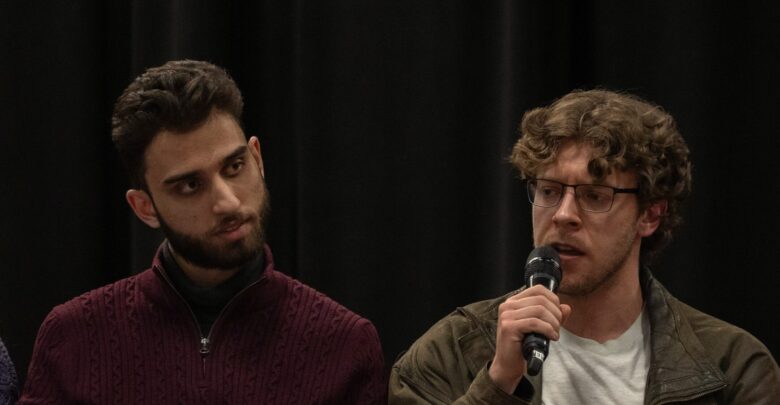
At the Indigenous Students’ Union (ISU) forum on February 24, Abdul Abbasi and Joseph Sesek offered two sharply different visions for how the SU should approach Indigenous representation, governance reform, and executive leadership.
Abbasi is running for a third consecutive year in the executive office, after serving two terms as vice-president (external) (VPX). He comes into the race with institutional knowledge, federal and provincial contacts, and a record he is eager to defend. He repeatedly framed his campaign around relationships that deliver results.
He pointed to tangible wins: $1.2 million secured for transit safety measures through the transit coalition, advocacy for the Indigenous Student Centre, and work at the federal level on the Post-Secondary Student Support Program. He emphasized collaboration with the ISU and positioned himself as someone who can convert connections into funding and policy movement.
There is merit to that argument. The VPX portfolio demands relationship-building. Abbasi has done that work. He also benefits from continuity. In a political environment where institutional memory often resets each May, experience carries weight.
But experience alone does not settle the question of leadership. It raises another one: what changes when someone moves from advocate to president?
At the forum, Abbasi often leaned on his past performance as proof of future effectiveness. When pressed on accountability, he pointed to what he had already delivered. When asked about power imbalances between the SU and the ISU, he returned to collaboration and better planning. His approach is incremental. Strengthen relationships. Improve coordination. Formalize support plans.
It is steady. It is pragmatic. It is also cautious.
Sesek’s campaign, by contrast, centres on structural reform. His most significant proposal is a permanent seat and vote on Students’ Council for Indigenous students, achieved through a bylaw change or referendum if necessary. His framing was blunt: “Being in the room as a guest is not the same as having power.”
That line landed because it identified a real tension. Consultation can become symbolic. Invitations can mask hierarchy. Sesek’s campaign is built on the claim that representation must be formal, not discretionary.
When asked how he would protect and advance equity initiatives, Sesek acknowledged that he cannot fully understand Indigenous students’ experiences and therefore needs institutional mechanisms to ensure their perspectives shape decision-making. That humility contrasts with Abbasi’s more managerial tone.
But humility does not equal implementation.
Sesek’s campaign relies on the assumption that structural reform will resolve tensions between the SU and the ISU. That may be partially true. A permanent seat would redistribute formal power. Yet governance reform alone does not guarantee improved relationships. Structures can codify representation. They cannot manufacture trust.
The Students’ Council already includes a Native studies seat — one that does not have to be filled by an Indigenous student, though it often is. It has gone unfilled in past years due to workload, recruitment barriers, disqualifications, or limited institutional support. That reality suggests the issue may not be the absence of a seat alone, but the conditions that make such roles difficult to sustain. Adding another councillor position without addressing those structural and practical barriers risks replicating the same problem under a different title.
On one side, Abbasi’s relationship-based leadership risks preserving existing hierarchies. On the other hand, Sesek’s structural promises without demonstrated executive experience risks overpromising and underdelivering.
This election ultimately hinges on a broader question: what kind of presidency does the SU need right now?
The SU is navigating affordability crises, transit safety concerns, and ongoing debates about representation and governance reform. Indigenous students have raised concerns about power imbalances and decision-making processes. These are not cosmetic issues. They shape institutional legitimacy.
Abbasi offers stability and established channels of influence. He speaks the language of policy and funding streams. He is comfortable operating within existing systems. His campaign suggests that the work underway simply needs continuation and refinement.
Sesek offers disruption. He frames the current moment as insufficient and calls for bylaw amendments to formalize Indigenous representation. His campaign implies that consultation without voting power is structurally inadequate.
Both positions respond to real concerns. Both leave gaps.
Abbasi could strengthen his case by articulating how the presidency would expand beyond his VPX track record. The president’s role is not just to secure external wins but to shape SU culture and institutional leadership. Relationship-building must extend inward as well as outward.
Sesek could strengthen his campaign by detailing how he would navigate council procedure, budget constraints, and executive coordination to pass a referendum or bylaw amendment. Structural change requires procedural fluency. The forum did not fully demonstrate that fluency.
There is also the matter of political tone. Abbasi’s emphasis on partnership signals continuity. Sesek’s language about past executive behaviour signals rupture. Voters must decide which tone better reflects the current campus climate.
The ISU forum proves that students are paying attention to representation, accountability, and delivery. The presidency demands all three.
The question now is who can realistically provide them.