SU Elections 2026 Q&A: Vice-president (operations and finance)
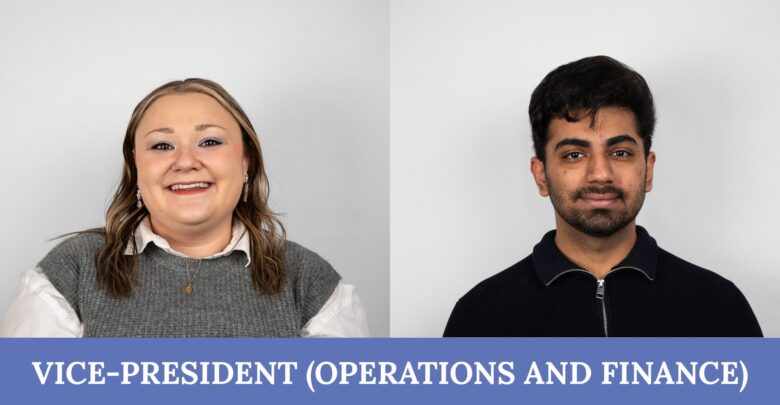
There are two candidates in the 2026 SU Elections vice-president operations and finance race: Armaan Singh and Logan West.

 Leah Hennig
 The vice-president (operations and finance) (VPOF) is in charge of the University of Alberta Students’ Union’s (SU) budget. They also manage and finance several of the SU businesses, including Dewey’s, Room At The Top (RATT), SUBmart, and The Daily Grind. They also oversee the operations of the Students’ Union Building (SUB).
Two candidates are running for vice-president (operations and finance):
- Armaan Singh, a second-year computer science student, and the International Students’ Association (ISA) co-vice-president (communications)
- Logan West, a sixth-year student in film studies and women and gender studies, and the current SU vice-president (student life) (VPSL)
The following interviews have been edited for brevity and clarity.
Why have you decided to run for VPOF?
Armaan Singh: I was going to run for vice-president (external), because I have a background in the United Nations, and I feel advocacy is something that I’m passionate in, but at the same time, i do think that there are better people instead of me who can do this job. Operations and finance is something I’m really interested in because I’m switching to business technology management, and also operations and social media comes under operations and finance, and more visibility for the businesses, etc.. I have a three-year background in social media and marketing. I have managed people from 25 to 35 million followers for three years. [I] also have worked with startups and brought them from like 3,000 to 1.5 million [followers].
A lot of issues with SU businesses are facing right now, there’s not enough visibility. The SU spent $540,000 on marketing, which is honestly a lot of money for really subpar results, and I want to change that because if you go to SU’s Instagram, it’s like 50 likes, 60 likes, or 200 likes. That is not good enough for $540,000 and also, most of the SU businesses, as you see, are in loss right now. I work at Dewey’s, so I do know all the nitty-gritties of working inside an SU business, and I do feel that most of the things are not optimized enough or efficient enough where they can make a profit. One of the things is that most of the SU businesses do not employ a lot of [U of A] students, a lot of positions are taken by students who have never been to the U of A, but are not recent graduates. But at the end of the day, SU is here to serve the students, and most U of A students are unemployed, which is difficult for them.
Note: Only two of the SU businesses have been projected to be at a loss in the last two budgets. The SU has budgeted $530,000 for marketing for the 2025–26 year.
Logan West: After spending a year in the role as VPSL, I’ve had the huge privilege and opportunity to advocate to the university and work closely alongside student groups, which has provided me with a unique insight into how the SU isn’t necessarily always performing at its best or meeting students’ needs. When it comes to the internal operations of the SU, I think there’s a lot of work to be done. I have had the privilege of working on the strategic plan and being a part of those conversations with my team. VPOF [Nathan] Thiessen and President [Pedro] Almeida worked very hard to finish that plan, but I’ve been able to see the ways in which they have truly built a vision for the future of the SU that I believe in. I want to be the person to be able to execute on those first steps as we step into the vision of a four-year plan, and this first year is crucial. It’s crucial to get off on the right foot as we proceed, so I really want to be part of that change and those first steps.
I’ve taken a year to be incredibly passionate on a lot of files for students, but I’ve also gained a year of experience with the organization combined with my passion for student issues would allow me to execute.
What would you say are the three main takeaways from your platform?
Singh: First of all is financial transparency. I do believe that the SU is really transparent because this whole document is really in-depth. I do feel somebody who could understand the financial documents would be able to understand every single thing. I do not come from a finance background; most students in the U of A do not come from finance. We need to make sure that this information is much more palatable for the students for them to understand what money we are paying, how much of that goes into governance, how much of that goes into events, how much of that goes into scholarship for other students, most people do not realize that you’re paying like $700 to SU. I conducted a study with like 300 students, not that big of number, but at the same time, 92 per cent of them did not realize how much money do they spend. They [guessed] $100, $200, but we pay $700 to the SU. I know that more than $400 goes directly to the U of A dental and health plan, but then out of that $705, only $165 is mandatory. Most students don’t know that.
The second point is sexual health reporting. I had two friends who went through it, which was really horrible. At the same time, I do realize that the Student Success and Experience (SSE) is really overworked right now. I wanted to bring up a streamlined platform where a student can choose not to report it, but still give all the information, so if the same case against that same person, from the previous victim, could be used as evidence, and it could be streamlined so they don’t have to face any shame. The third most important point was opt-in versus opt-out fees, which is honestly overlapping with the first one, that students should be aware of. How much of the money could be opt-out for because $540 could be the difference between somebody having groceries for two months or not.
Note: The SU membership fees for the 2025–26 year are $62.90 per fall/winter semester. The SU Health and Dental plan is charged annually for a combined total of $404.77, if starting in the fall semester. Students have the option to opt-out of the plan. There are additional dedicated fee units which students pay, unless opted-out of. These fees are paid to various campus or student organizations, including a few the SU.
West: The first takeaway on my platform, as I mentioned, is executing on the strategic plan. We have a four-year vision for the SU, but now it’s time to take those first steps. So developing those three-year operational plans for each department is going to be a key focus to ensuring that w’re executing on that. There are many goals identified as having to occur in the 2026–27 term. So as VPOF, stepping in when I can to support staff and ensure that those goals are met as well.
My second takeaway from my platform is supporting student groups. It’s incredibly important to me to ensure that student leaders are able to overcome barriers that are currently in place to support them. Whether that’s taking a look as we move into the next phase of the SU taking jurisdiction of student groups, whether that’s reviewing the ways that we’re doing our granting, or just looking at ways to better support student groups with their event processes. Ensuring that a council is taking a holistic view at the ways in which we can better improve those regulations, and communicate that to student leaders.
Lastly, what’s really important to me is ensuring that the SU is relevant both in its mission and its mandate. We can all say that we want to execute on this plan and we want to be there for students, but if student feedback is telling us that we’re moving in a direction that does not resonate with them, we need to be adaptable and flexible. Whether that’s with our businesses or our services or the way we’re communicating through marketing and communications. Ensuring the SU is relevant to students is a key priority for me.
SUB has seen increased maintenance issues and delays. How would you address these issues?
Singh: First thing, there’s preventive care. And the second part, if there isn’t already an issue, how could we solve it? One of the thing issues with the SU is it is not really good at allocating proper funds to proper places. For example, last year, $90,000 were allocated for sustainability fund, but only $20,000 of them were utilized. Those $70,000 extra were sitting idle. And there are other issues. For example, SUB building fund, which is honestly really low right now, and also it has been increased from previous year by seven per cent but honestly seven per cent doesn’t cut it. So use all those unrated funds which have been sitting idle from years and years and years and compounding there and better allocated towards SUB funds, or, for example, Campus Food Bank. So better allocation of funds, and also coming to the preventive part, making sure that students are educated about what the proper advocates are. I realize that we are, most of us are adults, but some still act like kids, so you got to educate them.
West: I think when it comes down to issues of maintenance delays in SUB, we have to remind ourselves that the university is largely responsible for the maintenance of the building. We do have authority over two-thirds of the building, the third that the university has it’s within their jurisdiction to maintain things such as our elevators, burst pipes that caused the doors to be closed for so long. However, what we have identified this year is that there are unique pathways in which we can get the university’s attention and apply pressure to ensure that those changes are being made in a timely fashion and that the university is fulfilling its end of its commitment to share this space with us. I believe it relies a lot on communication with students. Why are these delays happening? What is the reason? And what the expected timelines are? I believe that giving students a point of contact, like with did with the posters this year, definitely applied pressure to the university. Seeing ways in which we can improve that, but I think also creating a long-term plan for the utility of SUB and identifiying those maintenance gaps is incredibly important. Ensuring we develop a long-term vision for the building through a SUB master plan, which, from what I understand, Thiessen will be delivering on by the end of his term. It will hopefully help address some of those issues and set a vision for the next VPOF to execute on in their term next year.
How would you maximize the value students get from their SU fees?
Singh: I feel it’s a double-edged sword when VPOF says this, because at the end of the day, when I say I want to bring in more profit from the businesses, people just assume I want to raise prices, meaning students are going to pay more. But at the same time, students don’t realize, because everything in SU is for nonprofit, every single cent that Dewey’s make is going to go back and funnel back to SU, which we could have more events, more awareness weeks, for example. When I say I want to increase Dewey’s profits, for example, right now, Dewey’s is bringing down their price, everything under $10.50 which I’m really happy about, because I work at Dewey’s as well. But the thing is, that’s going to bring in more people, and our operations cost stay the same, but at the same time, costs increased. But at the same time, my profit was increased as well without increasing the price. Affordability is one of the big things which I’m going for this year, and also making people aware of where the money is being spent so they’re satisfied, like “hey, I gave like $165 in mandatory fees to the SU, okay these are the things which it was spent on. I just want students to be aware of where the money is going.
West: When it comes to talking about students’ value for their dollar, we have to remember that, as an organization that relies on nearly 40 per cent of its revenue being generated by student fees, every dollar that we spend must be a serious value judgment. Students deserve a return on their investment, and it is our responsibility to ensure that the money that we are investing and spending is impacting their student experience positively. In terms of our businesses and our services, I believe this requires a full-scale review of our operational plans that will be developed next year. Those three-year operational plans, identifying the ways in which potentially we’re spending money in places that we don’t need to be or are there ways our services can be improved to better meet their needs.
We also often walk the fine line of our businesses, businesses are social enterprises, and can we accept razor-thin margins, in exchange for students having affordable meals and places to drink and eat on campus. That’s a question that, in my opinion, students have expressed they prefer affordability, as we’ve heard often with spots like Dewey’s. As well as ensuring that we’re reviewing certain departments such as our marketing and communications, where we’re spending half a million dollars a year, and I’m not necessarily sure that students are feeling half a million dollars worth of impact in the engagement the SU is having with them. So finding ways to better internalize student priorities with our spending, as well as working towards addressing the strategic plan, diversifying our revenue generation.
How would you work to increase the transparency of the SU’s operations and finances?
Singh: One of the things is, I want to revamp the audit committee. The audit committee is idle for most of the year, for the first eight or nine months, and then for the last three months. They’re so horrible. The last financial report we have from SU right now is financial period 2023–24, and me, making my platform on that was honestly a little outdated, which is honestly not acceptable. I want the SU to publish a report at the end of every single term, for example, at the end of the fall term, winter term, and then the summer term. So that is how I want to make sure that the SU is held accountable, and also make use of infographics, graphs, and histograms, because this is not very understandable. As I said before, the SU is really transparent. It’s not just palatable for the students to understand what the SU stands for. SU has a lot of research, which most students don’t realize about. SU has a lot of advocacy things which most students don’t know, because they’re not marketed well enough. Even this the website was down and I had to specially email Nathan [Thiessen], “hey, the website is down, I need the financial budgets to do my platform.” I asked to get the financial sheets to 2023–25, and they’re not ready yet, which they were supposed to be because the last operating year has already happened, which was honestly not acceptable.
West: Transparency is a topic that comes up a lot, I think, when folks are running for VPOF. While I believe there’s always room to be more engaged with students and ensure that they understand where their value is going, I also think the SU is currently doing a relatively good job at being transparent, whether that’s uploading our council and executive minutes or adapting to feedback. Earlier in the year when we had students expressing that they couldn’t find our minutes, ensuring that we’re keeping up to date when we’re receiving feedback. You can find our financial statement and our budgets online as well, so students can take a look there. We also have plastered just about on every website and social media page, ways to reach us.
However, that doesn’t mean that there aren’t ways that we can be more accessible to students. Whether that is through utilizing finance and administration similarly to how I used it for member services to deliver more direct updates to members, specifically VP finances across their [student representative associations] (SRAs], regarding what the SU is doing on a monthly or bi-monthly basis and providing that more person update. Perhaps it’s reviewing our social media strategy. This year, we set forth a new social media strategy, which increased engagement with students, but there’s always room for improvement. There are ways to look at how we can better communicate if students have concerns about their finances and where it’s going. How are we better meeting that? So I think it really comes down to ensuring that we are adaptable and flexible when we’re receiving feedback and also creating spaces where we’re open to receiving that feedback in the first place. I believe the other piece that’s really important is when we’re talking about long-term investments, such as potentially renovating Dewey’s.
— With files from Leah Hennig and Kathryn Johnson
CORRECTION: A correction was issued on February 24, 2026 at 12:48 p.m. to correct that Armaan Singh stated that there was $90,000 allocated to the sustainability fund, not $9,000, and $70,000 left over.