SU Elections 2026 Q&A: Vice-president (external)
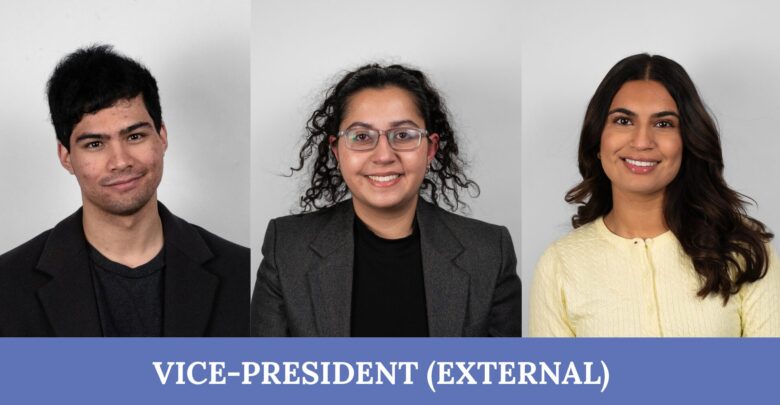
There are three candidates in the 2026 SU Elections vice-president (external) race: Arman Chauhan, Angel Raina, and Dustin Rodenbush.

 Leah Hennig
 The Students’ Union (SU) vice-president (external) (VPX) represents the undergraduate student body at the University of Alberta through external advocacy. They work with all levels of government on issues impacting students, such as funding. The VPX also works closely with post-secondary lobby groups, such as the Alberta Students’ Executive Council (ASEC) and the Canadian Alliance of Student Associations (CASA).
There are three candidates in the 2026 Students’ Union VPX race:
- Arman Chauhan, fifth-year sociology student and current VPX for the Organization for Arts Students and Interdisciplinary Studies (OASIS)
- Angel Raina, fourth-year political science and economics (honours) students and current speaker of Students’ Council
- Dustin Rodenbush, third-year political science student
The following interviews have been edited for brevity and clarity. Candidates were given 1 minute and 30 seconds to answer each question.
Why have you decided to run for VPX?
Arman Chauhan: I’ve decided to run for VPX because I have, through my governance experience with OASIS, which is the larger student representative association (SRA), and my time as an arts councillor, I’ve seen first-hand what advocacy and student advocacy for student needs does, and I want to use my experience to carry that on and get better groundwork done for students and their needs on government levels through this position.
Angel Raina: I think a lot of it stemmed from me feeling quite responsible for the world that is being passed down for me. I’m like, this is now going to be our responsibility, and a world that we need to be the stewards of as the upcoming generation. So, that mindset, and just that value base has led me to a lot of youth advocacy. I did high school during COVID[-19]. That was a very isolating time for everyone around the world, and the Black Lives Matter (BLM) movement was happening at the same time and I recall at that time really feeling like I was, I’m sure, along with many people, viewing the world like it was something external to me and it was just something I was witnessing rather than actively taking a part of. I think that’s the way a lot of young people feel when they look at the world. It’s just something that’s happening to us rather than something we’re actively engaging with. So I’ve just been passionate about youth and advocacy and all the roles that I’ve held where I’ve been consulted as a young person. But it’s a very interesting power dynamic to exist within and that’s something I think the VPX position has the potential to flip a bit. There’s more initiative and power, honestly, around the problems you decide to tackle, and I find that very interesting and meaningful about the VPX role.
Dustin Rodenbush: I decided to run for VPX, because as it says in my bio, I am in my third year of political science, and I do have a passion for public advocacy and government relations I already have some experience in this field, and I’ve talked with the current VPX Abdul [Abbasi]. He’s told me about the job, if I were to win. And it’s nothing I haven’t done before. I’ve gone to a lot of places, I do a lot of travelling and meetings already. So it’s kind of like a return to normal for me. I want to get more experience in the field because I plan to go into politics. And I know we did just hit the top 75 in the world for university rankings, which is really great. However, I see a few problems in this university, unbecoming of a top 75. And I believe, if we were to work with outside forces, like all levels of government, municipal, provincial, and federal, along with different companies, corporations and maybe other things like non-government.
Note: TIME magazine ranked the U of A 75th globally, however others placed the U of A lower.
What would you say are the three main takeaways from your platform?
Chauhan: The three main takeaways would be focusing on different levels of government. With municipal, I’m really pushing for transit safety, whether that be through the Transit Safety Coalition and the safety attendant program, just push for a safer transportation system. Provincially, I really want to advance, open educational resources and focus on getting a more stable or increase in operating grant. Federally, working with CASA to have a strategic plan going forward into seeing where students are going to benefit the most.
Raina: I’ll give you three themes that I’m working with. One: affordability. It’s a huge concern for everyone with, we see like the rise in tuition, universities not getting as much funding, which is being offloaded to students. So, we advocate around that for sure, but affordability as a whole, something has to do with food, with housing, I think that’ll be a big theme. We’re going to see funding from the federal government, making sure it transfers down to Edmonton and U of A students, affordable housing initiatives on that front. We’ll see it for transit and for the city, so that’s a certain thing that’ll definitely be happening. I think it’s going to be really interesting to see how I would partner across levels of government. So, like I said with funding, making sure that funding that we have at the federal level, making sure it translates down. And that’s something that’s gonna take advocacy and just being on top of it to make sure it does translate down to us. Also, I’d very much like to collaborate with organizations outside of the government. Government advocacy, it just goes without saying, it’s the VPX role. But I think we’re really lacking in building meaningful relationships with people who aren’t just the federal, municipal, provincial government, so like non-governmental organizations (NGOs), unions, things of that nature.
Rodenbush: I’d say the three main takeaways from my platform would be to make sure that future allocations of funds go to fixing the places that need to be fixed the most. Just for example, this morning the elevator that I was in broke and I ended up being trapped in the stairwell. The second one would probably be to make sure students have a good deal and are able to support themselves. Being able to make sure they get the resources they need. Additionally, because that’s to do with the student grant cuts. This is a personal issue for me, even, because I do student grants as well. I have a full summer job, I work nine hour shifts five days a week, but even that’s not enough for me. And my third thing would be to continue to have good relations with the government.
International students are facing pressures including higher cost-of-living and tuition, cuts to new study permits, and conflicts at home. How would you address these concerns and advocate on behalf of these students?
Chauhan: I would begin by focusing on what each, again, different levels of government could provide for students. So for municipally, seeing how we can fundraise for an increase in the Campus Food Bank, making sure that we can stabilize rent prices or increase housing, doing what we can to, again, increase resources that are available to them to lower their burden. As well, internally with SU, making sure that they have enough resources to feel safe and that they have places to go for any type of mental health burdens or for loans as well, if they need to. So, provincially, making sure that they’re getting their loans at a faster rate, we’re going to focus on increasing the speed at which they get their loans. So making sure that whatever avenues we have for them, they can go to get the resources they need.
Raina: For international students, I completely agree, it’s a very, very difficult position to be in. As far as the [study permit] caps and the federal government are concerned, I’m not sure to what extent the SU would have power to advocate on certain things. It’s just such a high-level policy that it’s very difficult to address. And then there’s also the matter of supporting, and I think it’s very important, and I’d like to do work around decreasing the stigma around international students and really conveying how meaningful they are to our economy and to our country and that immigrants really make this country what it is. But apart from that, I think it’s also very, very important to support the international students that are already here. So one thing is bringing them in, the other thing is supporting them as they are here. And I think it’s best done to the services that they see on the ground every day. So on the municipal level, I would definitely have in my platform some work around newcomer support services, connecting international students with a lot of the organizations that already exist in the community. We have a lot of cultural organizations within the university and outside of it, that there isn’t a connection there, and that’d be something to make. Also, safety with transit, you know, making it more so a de-escalatory approach rather than the police.
Rodenbush: It’s really similar to my policy platform. Like I said, the high cost-of-living. Students really need a better deal, because even for domestic students like myself, I’m barely cutting it with student grants, which have yet to be cut, let alone these international students. For example, my roommate, he pays like four times as much as me for tuition costs and they’re getting the cuts. So it’s a very scary thing. I wouldn’t say I know it personally myself, but, my roommate is a really good friend of mine. He’s worried, and it’s not even just about in school. It’s out of school too, because of the job market. He is in engineering. You would think he’s an engineer and he has good grades so he would be able to get into a co-op program or something like that easily, he’s not though. So I’d say, I’d like to work on getting more companies and corporations to co-operate and go into our co-op programs, hiring fresh undergrads. And also for that, like I said, the student grant cuts are important, too. And I would like to try to see the cost-of-living reduced for some of these residences, because it’s really hard for international students to find a place like where I’m in. So residence is mostly the only choice for some.
How would you keep students informed and engaged with your advocacy?
Chauhan: One of the biggest things is definitely social media. We’ve seen a large engagement with students through social media, making sure that we’re transparent with what we’re doing along the way, as well as releasing any type of surveys or resources for their input, so they’re alongside every step of the way and not just towards the end when everything’s been done. Another way would be using any type of advertisements we have on campus, making sure that as VPX, I’m out there engaging with students on campus, so they do know what’s going on.
Raina: This is a really interesting question because it’s been an overarching issue for the SU as a whole. I know we had some big wins this past academic year, and we’ve seen an uptake in our social media usage because of that and social media viewership. I think people are a bit more aware of what this present SU has done because of that. I think that’s definitely something to capitalize on and continue, those short bite-sized videos conveying like big policy outcomes, etc.. Also, something I think the VPX does less of, but can do more of is interacting. A lot of the VPX’s time and interactions, such meetings taken up by like these external advocacy organizations. I think it’s important that the VPX also take on a bit of the labour load of interacting with people on campus more, which the world requires and we do already, but just being more mindful of which gatherings one chooses to go to and which one doesn’t. I think that would be a lot of the work that we do, but it has been an overarching issue for the SU.
Rodenbush: I’d say, in order to keep students more informed and engaged with my advocacy, I would definitely like to make things more transparent. Maybe creating a monthly or bi-monthly report to show what I’ve done and what I’ve yet to do, like what is on the to-do list. I’m a really big fan of transparency and I like to get stuff done and to be productive. I think, is a really good thing for myself. To keep it engaging I’d say that’s what I’m also planning to do with my platform. I plan to extend it past my campaign platform into everything to keep [students] engaged. Students are super busy, they don’t have a lot of time. So instead of a full PDF with a lot of jargon in it, I just want to crunch it down as concisely as possible, just to simply give them the facts and just the facts, no fluff. So students can read it easily and have time to do other things while being informed about all the stuff I do is VPX.
How will you leverage external advocacy groups like ASEC and CASA?
Chauhan: I would leverage them by making sure our priorities align and the plan we have for students all co-align for us to see larger results. So federally, making sure that my platform, what I would want to bring to students for the U of A, aligns with CASA’s promise to help students federally. Same with provincially. It would be a win for all students rather than just focusing on U of A specifically, making sure that we’re working collaboratively and along with provincially too, I want to increase cross-campus collaboration, so that way we can share resources.
Raina: I think these are wonderful advocacy bodies that the UASU has always had a strong role to play in, especially this year with [Abbasi] being the CASA chair. I think we’re already a meaningful part of these organizations, and that’s something to continue. As far as specific policy outcomes, I think it’d be really interesting with the provincial body to look at increasing non-repayable financial student aid. I think there’s room for that, and I think that’s something ASEC advocates on and having to be a part of their platform for the provincial government, who, to a certain extent, is willing, through the Mintz panel has been recommended to change the way they fund universities and students. I think this would be a great time to use that organizational body for that.
On the federal side of things, CASA already has great things that they’re advocating on, and I think it’s important to capitalize on that and continue with that work just to make sure we see it to fruition. So, that’s a lot of stuff around housing, really calling on them to build a student housing strategy and make sure that the $2 billion asks of the $10 billion for affordable housing that we’re making is passed down to students. And Edmonton’s a big city, so we definitely get a decent chunk of it and then collaborating with the government to make sure U of A students see that.
Note: The $2 billion for student housing is also for seniors’ housing.
Rodenbush: When it comes to ASEC and CASA, although it would be my first time, I would say I have been with organizations before. I’m a unionized worker. I’m not from Edmonton but I work for the city back home. So doing stuff like meetings for unions. So I’ve done this stuff before, and I’d say as long as we keep unified, we would be able to have the power to push back on really harmful legislation from any form of government, whether it’s provincial or federal or municipal. I’d say being able to [have] good relations and keep unified with everybody in ASEC and CASA.
-With files from Leah Hennig