SU Elections 2026 Q&A: Board of Governors representative
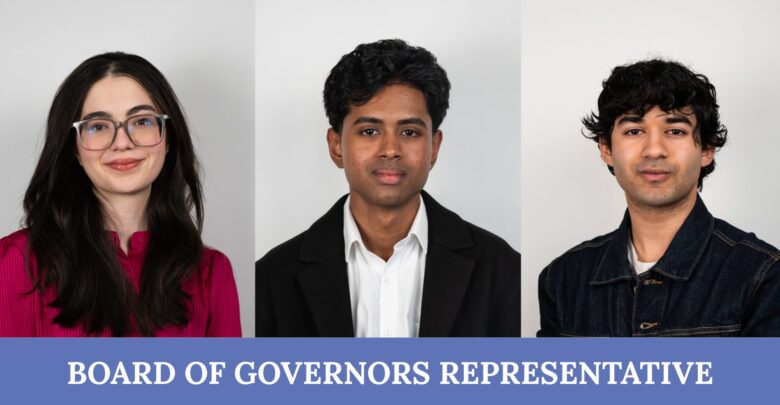
Three candidates are running to be the next Board of Governors representative: Amaan Khan, Tala Mojarrad, and Janardhun Alagarsamy Vignesh.

 Leah Hennig
 The Board of Governors (BoG) is the highest governing body at the University of Alberta. BoG has seven standing committees and oversees the university’s property, finances, strategic direction, and overall operations. BoG members include the U of A’s president and vice-chancellor, faculty deans, and administrative staff.
The BoG representative holds a voting seat on BoG and represents undergraduate students at BoG meetings. This individual collaborates closely with the Students’ Union (SU), and participates as a voting member on both the Students’ Council and General Faculties Council (GFC).
There are three candidates in the 2026 SU BoG representative race:
- Amaan Khan, a fourth-year computing science student and a 2025–26 science councillor on Students’ Council
- Tala Mojarrad, a third-year medical laboratory sciences student
- Janardhun Alagarsamy Vignesh, a third-year neuroscience honours student
The following interviews have been edited for brevity and clarity. Candidates were given 1 minute and 30 seconds to answer each question.
Why have you decided to run for BoG representative?
Amaan Khan: As a fourth-year in my faculty of science major, I’ve been around campus a lot. I’ve been involved with a lot of aspects of the student experience, and just been a lot of roles, including, but not limited to, governance, residence, life, and even just student experience in general. It has given me a lot of adaptability, a lot of experience in various roles, and it has given me opportunity to interact with students at a personal level and at a large level. One thing that I’ve noticed in that is that there’s a noticeable disconnect between BoG and the student experience. People don’t know where to go for governance or where to go to get their matters or concerns addressed. I just want to use my experience in governance and just the experience that I’ve gathered over the past four years over various roles in campus, and using them to leverage my understanding of the BoG and just bring the best representation I can of student experience and student life to the board, and just make sure that governance is for the students and it is including the students.
Tala Mojarrad: Personally, I’ve experienced a lot of disconnect between the university and the student body. Students give a lot of meaning to the university, and I believe their perspectives and their needs should be integrated into academic decisions and all the decisions we make about student life in order to increase our academic validity and output in, overall, the university. That’s pretty important to me. I also believe that I have the ability to create that better connection and communication between students and university overall through all the experience that I’ve had, as I’ve done a lot of involvements in university life.
Janardhun Alagarsamy Vignesh: I do have previous experience in terms of governance in the sense that I’ve been part of the academic planning committee, as well as, right now, I’m on the Council on Student Affairs (COSA) and I’ve also been involved in judiciary bodies, and I feel that as the BoG representative, I would have the ability and far more leverage than I currently did in the previous positions because a lot of things that came to the table were for discussion and I believe having this role would enable me to further amplify voices and be in a place where I have a lot more leverage and where I can work with other executives, I can work with Students’ Councils. I can work with other student groups, such as the International Students’ Association (ISA), the Indigenous Students’ Union (ISU), and just overall just have more say and amplify the student voice as opposed to just being in a sort of limited role.
What would you say are the three main takeaways from your platform?
Khan: Three main takeaways from my platform would be affordability, transparency, and engagement. Affordability is directly translated to the decisions that take place at the board, because they directly affect student life. And just making sure that there’s accurate representation of what student experiences at the board is going to be very important, because the BoG representative is the one vote that is the student representative vote at BoG. The second one would be transparency. A lot of decisions that happen at BoG is behind closed doors, so there’s a lot of opaqueness. Pushing for transparency in that space is going to be a huge win for any BoG candidate, and that is something that would be one of my main focuses in my platform. The third would be engagement, and making sure that students are engaged and they are aware of what happens in BoG and just what the BoG representative does, and just making sure that I can use my experience to enhance the student experience on campus and meaningfully integrate their experience into what can be represented on the board level and the best interests of the students.
Mojarrad: Resource accessibility, documentation platform, and empowering student voices through community building. Those are the three main things I want to focus on, especially with a lot of discrimination and a lot of issues happening with co-ops, student placements, and clinicals. We’ve experienced a lot of bias and a lot of discrimination against students. It’s important, of course, to have that platform for students to document. In health care, we say if something isn’t documented, it didn’t happen. This is also empowering students through community building, creating a sense of community within students through mentorship to empower students’ voices itself, to allow them to come and talk to us, and let us help them as well, making sure that their voice is heard as well. Also with the resource accessibility, I believe that the university has really good pillars and really good resources already available to students, but making sure that the students can access those resources all the way through is really important to me as well.
Alagarsamy Vignesh: I would quantify them as sort of pillars or like governing philosophies. First thing is oversight. When I say oversight, I mean both oversight in the sense that as the representative, I want to oversee BoG and then sort of communicate the proceedings to the students. But at the same time, the students should also have oversight over myself and then hold me accountable and give me consistent feedback so that I may work it into any general proceedings. The other part is going to be sustainability. We are all students at the U of A for a particular reason. We value the integrity, we value the name of the university, and we’re obviously here for a good education at the end of the day. So, a lot of things that the university is doing is currently well done, and I want to increase the sort of accessibility in those capacities, but at the same time, my last point is going to be advocacy in the sense that there are systems that can be improved upon. The accessibility can be improved. A lot of resources do exist right now, but the key problem is students are unable to find them and they’re unable to have that transparency. I believe that by having a given platform, I will be able to uphold these three pillars and sort of ameliorate this from the experience.
The BoG representative has limited resources and support in their role. How would you execute your platform without a budget or institutional support from the SU?
Khan: The BoG representative is a very nuanced role. The way that I’ve approached this question is I’ve had extensive consultations with the previous BoG representatives, and I’ve had extensive consultations with them regarding on what needs to be focused on, what is already done, and what we need to be focusing on for the next BoG representative, which would be after whoever would be elected this year. And so the main consultation process involved a lot of engagement, a lot of collecting data, and just making sure that I’m delivering a combination of data driven approaches and also students’ personal student stories to the board, because there needs to be a structure to everything, and the board really, really appreciates that. So just making sure that I’m able to meaningfully execute a combination of both and bring it to to the board in a way that is viable and in a way that is institutionalized would be the best form of approach to this.
Mojarrad: The documentation platform allows experiences to be gathered over time, building up on Adrien Lam‘s previous BoG survey, which is awesome, we have the data that we need to kind of move towards our advocacy and create the priority that we need to work on in SU and BoG, but also staying respectful, understanding, and kind of educatively advocating for student voices, I plan to ensure that everyone’s voices are heard and nothing is lost in the middle, and also developing those professional networks and communications and following up on matters as appropriate because I often notice that a lot of these issues of projects that we start initiatives that we want to, they kind of get lost and like kind of making sure that the appropriate follow-ups and solutions are kind of being made with the appropriate person is made as well. That documentation platform allows for an extended amount of time to let students document whatever is happening throughout campus and giving us a broader perspective, better stories, and more specifics so we can work on those.
Alagarsamy Vignesh: I view the BoG representative role as sort of a “jack of all trades” role in the sense that you have a lot of leverage in who you can work with. I can work with executives. I can work with, as I mentioned before, the Students’ Council and different student groups. I think the key value in this position is how much I can collaborate with others and get a bunch of different opinions and this doesn’t mean just collaborating with the higher ends, right? It also means coming down to a grassroots level and operating with students, consulting with them, and understanding their issues in their day-to-day lives.
The BoG representative is responsible for raising student issues at university governance meetings and with people in high leadership positions at the U of A. How would you make sure that your advocacy reflects student issues at large and is effectively communicated to university leadership?
Khan: BoG is a very collaborative decision making body, and the BoG representative isn’t simply an advocate. Their role is to build relationships and to effectively juggle the obligation that they have to the students to represent them most faithfully and to honor the fiduciary duty that they have to the institution itself. And the way that is best approached is with the systems are already in place. So effective planning, understanding the financial constraints that the university faces when making decisions based on tuition, academics, residence, cost-of-living, and skillfully navigating that space within the board and with each board member is going to be a very key component of making sure that there is effective representation of the student experience and effective representation of what students want, what the students need, and what the students should get because decision making regarding students should be with students and should be for students.
Mojarrad: I have represented as the vice-president (academic) (VPA) on the Health Science Students’ Association (HSSA), and one of the things that I strongly believe in is educational advocacy. That means that you educate people on different perspectives and then advocate for their voices. Often we don’t know and we don’t have a lot of perspectives and a lot of the things that I did as VPA in HSSA was that I created those opportunities for different perspectives for different professionals to understand each other — medical students, nursing students, occupational therapy — all of those to create better perspectives so we can work as a team.
I believe the university and the students are both a team, that we’re all overall working towards an academic excellence all over the world. If we can make sure that the team understands each other, that will help us a lot to move together better. Staying very respectful, again, being through health care and having to communicate within health care has allowed me to stay very professional and very respectful, but still making sure your voice is not lost and your point is still getting across. Also, as an international student, I understand that there are a lot of there are a lot of struggles, especially with experiencing multiple crises in your country … and I want to make sure that I can enhance the student experience by being their voices and amplifying their voices as much as I can while being respectful and considerate.
Alagarsamy Vignesh: I’m going to use the analogy of a tree. I think we as students are all the essential roots of the university, right? We are the fundamental components of it, and I believe that as the BoG representative, I would essentially act as the stem. What I mean by this is I would set up a platform where I can sort of engage with students more, sort of gauge where their interests are. The key is to have the data and have the information because, without that, we cannot operate in any capacity. And from there, I think, the second part of this is initiative. So, as the stem, you would essentially have to branch out to the different leaves, the branches, so definitely working with, in collaboration with other executives, and overall amplifying the student voice and taking the initiative and making sure that in BoG, students’ opinions and voices are heard because governance is often, from what I’ve seen especially, is pretty disconnected from the daily student life and I want to sort of bridge that gap and help people understand that BoG and the university is here to help them as students, and this obviously includes the other smaller campuses of Campus Saint-Jean (CSJ) and Augustana as well.
How do you plan to engage students in your advocacy and keep them informed of this work?
Khan: In addition to my experience as a councillor on the SU Students’ Council and the dean’s advisory committee, and just my past experience as being various roles in residence life and even volunteering for Week of Welcome, and just various experiences that I’ve gathered over the past few years on campus, I’ve gathered a lot of student input, and some ways that I’ve figured out to make sure that I catch each and every perspective of student life is to just rely on what the previous BoG representatives have done. They have done a great job and the way that I’m going to be approaching this, if I get elected, would be to combine the anonymous survey website data with structured consultations with Augustana, CSJ, and student representative associations (SRAs) like [the] ISA and ISU, etc., and just making sure that there is a good blend of both personalized stories, data, and one-on-one consultation. To further that, I have interacted with the previous BoG representative, Adrien Lam, and agreed to internalize and pass down the anonymous survey website to the next BoG [representative] to make sure that the student body has a united voice and one voice at BoG.
Mojarrad: We have many student bloggers on the U of A campus and their platforms and the social media have a lot of integration with students and students interact with them a lot. I believe they are really great resources to create engagement with students and with the SU and making sure that the students come and talk to us, again, kind of closing that gap and disconnect between the student body and the student governance. We have great, again, as I mentioned, resources and infrastructure for student involvement and participation. We have Perks, of course, which allows students to participate more. I talked to many students that don’t know about them, so again, using the social medias because everyone’s opened their phone and seen those things, and then also making sure that I’m in the videos and encouraging students to use those videos and using free resources on campus already, again, certain resources that we have in maybe we have the [artificial intelligence] (AI) students that are doing research using those resources altogether, making sure that we are using resources within the U of A to help students.
Alagarsamy Vignesh: I think we live in a period where social media and online platforms are very important, and I believe I will be exercising social media to the best of my ability so that I can create content and give information about proceedings in a way that is meaningful to the student and understandable because for the most part students don’t really care about a lot of extra jargon and such, so the best possible way would be to create bite-size or informational tidbits that they’re able to pick up on and be engaged with. With that also goes the inward sort of engagement where I want to set up consultations with students. I want to be able to be a friendly face on campus where they’re able to come to me and be like, “hey, I have this issue” and I wanna be able to sort of either I can, one, answer the question or I can work with them to find a solution for it, but at the end of it, and if I don’t have the answer to the question, find the answer to the question with them and don’t leave them hanging and be a sort of solution to a problem that may occur.
Students have raised concerns about BoG’s transparency. How will you ensure students feel BoG’s decisions and operations are transparent to them?
Khan: This is one of the platform points that I have and one of the main concerns that I had was, as I mentioned earlier, the disconnect between BoG and the students. Transparency is a real issue because there’s a lot of opacity within the whole structure and the decision making process of BoG, so effective ways to make sure that the students are aware and constantly up to date with what’s happening is constant updates before and after each meeting, constant executive reports at council, consultations with SRAs and providing them with specific reports regarding advocacy initiatives and any specific concerns that they may have, and just approaching everything through a very structured way because at the end of the day, the board really likes hard facts, and that is what they’re going to appreciate. To make sure that everything is done equitably and student centric, I’m going to be holding consultations with all three campuses because that’s what we want: three campuses, one student body, and one voice at BoG, which would be the BoG representative.
Mojarrad: I already have some familiarity with the council and BoG and how they work and how they have closed sessions. Of course, the university students do trust us a lot, but a lot of the things that are discussed in closed sessions cannot leave our sessions, and now I completely understand how students might have issues with transparency, but the decisions in the main projects and initiatives we’ve been doing have been documented by students on a social media platform called “this person is BoG,” and they also share all the projects and all the follow-ups, actions, and all the progress that they’re making on there. Also, making sure that I update students on a month to month basis or a biweekly basis on all the progress that I’ve made on a platform. The Gateway also updates students on a lot of these progressions, but also kind of collaborating with The Gateway to ensure that all of these progresses are recorded as they’re mattered to ensure that students are aware of what [the] BoG [representative] is doing with BoG and how their decisions aligned with students as well.
Alagarsamy Vignesh: As I mentioned before, the key comes down to providing the information in a way that is digestible to the student, and in terms of transparency, I believe the best practice is to analyse policies and analyse decisions that are being made and convey them in a manner that impacts the students. What I mean by this is we don’t want to give students information that may not necessarily impact them, right? We need to present it in a way that[’s] [like] “hey, this is what’s occurring and how exactly does this impact you as a student? What does this mean for your future, your program, your degree, the integrity of the university, and the overall namesake?”
–With files from Leah Hennig and Kathryn Johnson