 Leah Hennig
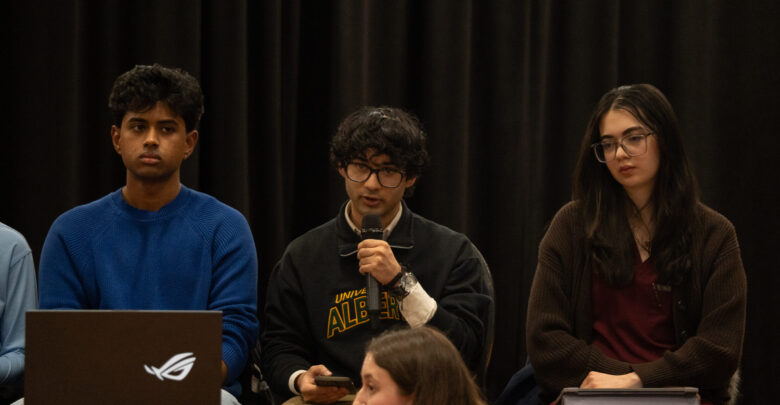
 At the Indigenous Students’ Union (ISU) forum on February 24, the three Board of Governors (BoG) Representative candidates made it clear that Indigenous students must be heard at the highest levels of governance. What was less clear, however, was how meaningfully their approaches differ. And, what that means for Indigenous students looking for concrete change rather than familiar promises.
The BoG at the University of Alberta controls tuition, approves budgets, and oversees long-term strategy. For Indigenous students advocating for protected funding, dedicated spaces, and meaningful consultation, the BoG representative is one of the only direct student voices in that room. At the forum, Amaan Khan, Tala Mojarrad, and Janardhun Alagarsamy Vignesh each presented a vision for how they would carry Indigenous priorities in that room.
Khan’s campaign rests primarily on transparency, structured consultation, and message delivery.
His central framing of the BoG representative is as a messenger. Someone responsible for gathering student concerns and delivering them clearly and consistently to the board. Khan emphasized structured consultation with ISU, collaboration with the Truth and Reconciliation Action Committee (TRAC), and the importance of bringing both survey data and lived experiences into governance discussions. He speaks about improving information flow and preserving voices in rooms where they are often absent. Sustainability, in his language, means avoiding performative gestures and embedding Indigenous concerns into ongoing reports.
On tuition and affordability, his approach again centres on consultation and evidence building. The leverage point is pressure through documentation and collective narrative.
Khan’s pillars suggest a belief that governance improves when communication improves. The lingering question is how far that messenger role extends when communication alone does not shift outcomes.
Mojarrad’s platform revolves around educational advocacy, accountability, and accessibility.
Her key pillar is what she called a “documentation platform,” a structured way of recording student experiences and ensuring those accounts are formally presented to the board. She frames the disconnect between students and the board as both informational and relational with governance feeling distant, jargon-heavy, and inaccessible. Her perspective is rooted in bridging that divide. For Indigenous students, she connected this to generational trauma and the difficulty of navigating systems while overwhelmed.
Rather than positioning herself as oppositional to tuition increases outright, she focused on improving understanding, accountability, and access. Her philosophy suggests that governance improves when students are educated about it.
What remains less defined is how documentation shifts outcomes when decisions are ultimately financial. Her approach depends heavily on the assumption that information will lead to better decisions, an assumption that governance does not always confirm.
Alagarsamy Vignesh presented the most explicitly structured framework: oversight, sustainability, and advocacy with purpose.
He spoke directly about tuition increases, performative inclusion, and gatekeeping in governance. His language suggested a willingness to question institutional logic, asking whether fee hikes are necessary and why consultation so often happens at the end of a process rather than the beginning.
His strength lies in his clarity of critique. By naming structural problems, he positions himself not just as a participant in governance, but as an examiner. His framing of housing and food insecurity as governance failures signals a readiness to challenge narratives.
Alagarsamy Vignesh presents a large critique of governance, but BoG operates meeting by meeting. The question is not if he understands systemic problems; he clearly does, but how he would translate that broad critique into concrete, achievable actions within a single year in his role.
All three candidates clearly value Indigenous partnership. All reject performative inclusion. All promise to consult ISU regularly. The three candidates left the forum with broadly similar commitments. If this race is to feel decisive rather than interchangeable, candidates need to sharpen their contrasts. For a role that carries influence over tuition, funding, and reconciliation commitments, alignment alone is not enough.