 Leah Hennig
 At the Augustana campus forum, Board of Governors (BoG) Representative candidates were asked one of the most practical questions of the election cycle: what improvements would they demand in exchange for supporting a tuition increase?
The question moved beyond values into negotiation. As one of the few student votes on the Board, the role requires not only listening but defining what representation looks like when decisions carry financial consequences.
While both candidates emphasized relationships and consultation, their approaches to Augustana differed in focus.
Amaan Khan’s remarks were consistently anchored in the campus itself. He framed his platform around ongoing consultation with the Augustana Students’ Association (ASA), post-Board meeting check-ins, and the use of anonymous survey data. Khan positioned Augustana not as a peripheral constituency but as a site of ongoing governance work.
His opening connected broader platform priorities, housing infrastructure, rent pressures, and international student retention. Khan’s reference to a reduction in international student tuition at Augustana wasn’t totally accurate. Tuition was significantly increased rather than decreased. But applicants for Bachelor of Arts, Business Administration, and Science can receive a tuition grant of up to $11,000. Mistaking a policy detail in a forum centred on affordability carries weight, particularly when candidates are positioning themselves as informed intermediaries between students and governance.
On the tuition question, Khan again emphasizes process, positioning student data, ASA advocacy, and campus feedback as the basis for how he would approach tuition decisions. The response worked to anchor decision-making in Augustana’s context, even as specific conditions remained unclear. The response showed a clear effort into ground decision-making in Augustana’s context.
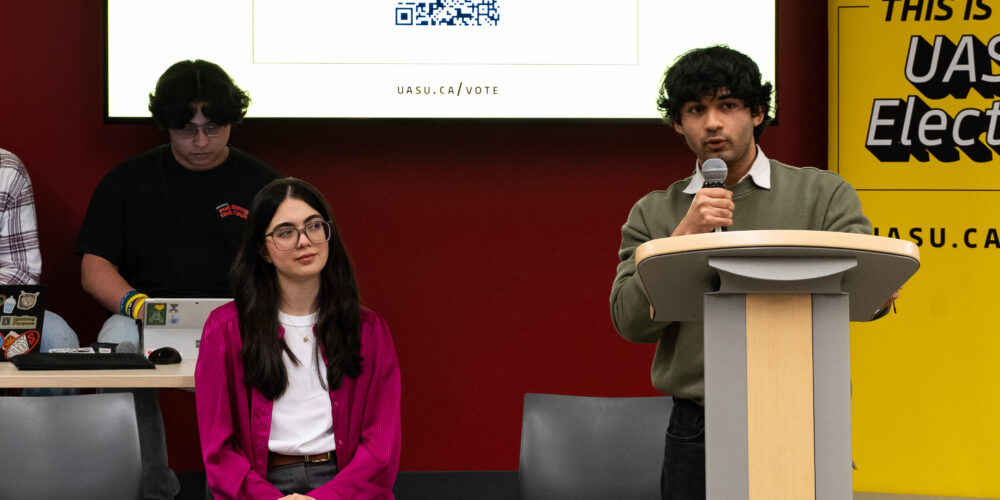
Tala Mojarrad’s approach centred more heavily on personal experience. She framed her candidacy through her position as an international student navigating limited resources.
In her opening remarks, Mojarrad noted that she has not been able to visit Augustana because, as an international student with limited resources, she does not have a car. The comment was offered in a way to illustrate the practical barriers students face when accessing campus opportunities. This grounded an argument in accessibility to the campus, but left a gap when she did not outline specific measures that would make Augustana physically more accessible, such as transportation, scheduling, or service expansion.
When students asked about tuition trade-offs, Mojarrad spent significant time explaining why tuition decisions are complex and how her experience shapes her advocacy. Those points aren’t irrelevant; they just weren’t exactly what the question was asking.
The clearest part of her answer came near the end: resource parity, mental health supports, and improved security as her concrete priorities.
Mojarrad has repeatedly positioned a documentation platform as a central priority. She described a space where students would record experiences in co-ops, clinicals, and other forms of experiential learning, referencing the health-care principle that “if something isn’t documented, it didn’t happen.” Despite the emphasis, the proposal remained difficult to parse. It was not clear what the platform would look like, who it would serve beyond specific program pathways, or how recorded experience would translate into governance action. The explanation moved between ideas of recording and advocacy without defining how those functions connect. In the end, the explanation raised more questions than it answered.
Janardhun Alagarsamy Vignesh did not attend the Augustana forum, citing a personal emergency that occurred while travelling to the event. In a letter shared with The Gateway, he said he had “every intention of being present” and would not have missed the forum unless he was “genuinely unable to do so.”
In the letter addressed to Augustana students, Alagarsamy Vignesh describes the absence as a missed opportunity to engage directly with a campus he values, writing that being present to listen and participate in “meaningful dialogue” is a responsibility he takes seriously. He said he welcomes opportunities to connect with students directly following the forum and encourages outreach through email or meetings.
UPDATE: This article was updated as of 9:31 p.m. on February 27, 2026 to include more information about the tuition decrease.