 Leah Hennig
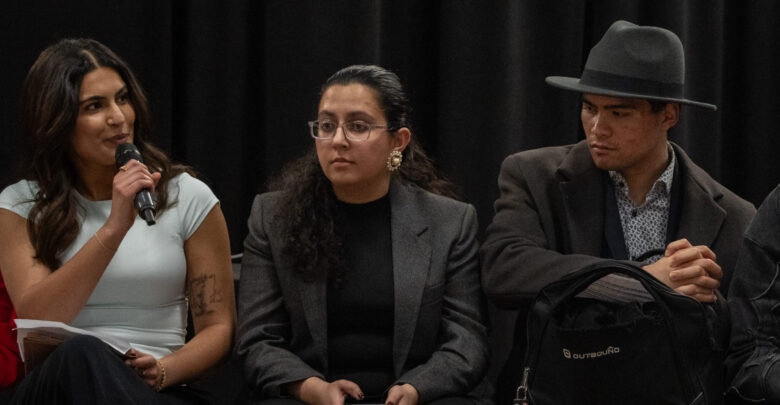
 At the Indigenous Students Union (ISU) forum for the 2026 University of Alberta Students’ Union (SU) elections, promises were made all around by vice-president (external) (VPX) candidates. Between the three, Arman Chauhan, Angel Raina, and Dustin Rodenbush, no one really shined.
In his opening remarks, Rodenbush said he plans to be available to hear out concerns and focus on on-campus issues. And this was consistent. For Rodenbush, he just wants to make sure those who need help are heard. While the sentiment is well placed, how exactly this would lead to action in his advocacy is unclear.
He also mentioned advocating to the provincial government to create more support for graduating students. However, his facts don’t seem to be straight. Rodenbush said unemployment for people aged 15 to 24 is at 12.8 per cent as of January. But it’s actually even higher. Youth unemployment was actually sitting at 14.1 per cent in January. He also mentioned planning work with the Council of Alberta University Students (CAUS). That would be great — if CAUS hadn’t dissolved. As a whole, Rodenbush kept close to home, trying to tackle issues that students face here on campus. However, he was misinformed on a pretty important topic.
Rodenbush maintained consistency throughout the forum in his desire to be accessible to students. This is fully doable, but is also a basic part of the job. He did show some knowledge of advocacy avenues, saying he wants to work with the Canadian Alliance of Student Association (CASA) and Alberta Students Executive Council (ASEC) for advocacy at all levels of government.
Alternatively, Chauhan, current VPX for Organization for Arts Students and Interdisciplinary Studies (OASIS), listed a ton of goals. She said after consulting with the ISU ahead of her campaign, one of her major goals is student involvement. Specifically, maintaining and fundraising for the Elder Grant to ensure the ISU has sustainable support when they need it.
She noted housing as another concern, specifically for Indigenous people, as they are disproportionately affected by homelessness. However, she never actually said what she’d do about it. She also said she is pushing for open educational resources to help alleviate cost pressures when facing band funding delays, dependants, and textbook costs being steep. Her last goal is to partner with the city to expand Indigenous mentorship programs. And these are all great plans, however, some of them are missing plans to execute them.
Chauhan later commented that if there are issues, the ISU “flags it right away.” While seemingly meant as a compliment, realistically, this is putting the job of ensuring Indigenous representation on the ISU when it shouldn’t be. If afforded the position, Chauhan should be seeking them out herself. They should be considered throughout the process like Raina had pointed out.
Raina said she wants to involve the ISU more by initiating conversations on various matters, but didn’t identify any specific examples. One main goal she did mention, though, was plans to work with the municipal government. She said that there’s currently a big push from municipalities to work with Indigenous communities. And Raina had two specific collaborations in mind. The first being an action plan on Missing and Murdered, Indigenous Women, Girls, and Two-Spirit (MMIWG2S). The second is to advocate to pair peace officers with social workers to get them appropriate training for de-escalation. Not only are they great plans, but they’re unique in a race with a lot of the same ideas flying around.
When questioned about how they’ll Indigenous governments, Chauhan said she plans to work with the City of Edmonton to create more mentorship programs. She said her intention with that is to hold politicians accountable to promised resources. Sadly, none of these listed answers actually answer the question.
Raina said this question brought up a big part of her platform, that being community building. She acknowledged that oftentimes, Indigenous governments are not involved in decision-making. She explained that, to build community, new relationships need to be built to further policy.
Rodenbush, holding true to the question asked of him, said he would establish a point of contact with tribal councils.
Overall, none of the three candidates are looking to be a great choice. Furthermore, all need to pull themselves together. With repetition and side-stepping of questions to uninformed takes, each candidate has something to work on.