 Emily Williams
The federal government plans to reduce the number of new international study permits. This comes after last year’s cap, which reduced international student intake nationwide to address housing shortages and to crack down on abuses within private colleges. The story the federal government sells is clean: fewer international students will mean less demand on housing, lower pressure on cities, and fewer vulnerable students being defrauded by bad actors. But there is nothing neat about how this policy hits Canada’s public universities. You cannot cut the main source of institutional revenue and then claim the fallout will spare domestic students.
Universities do not survive on imagination. They survive on tuition, institutional grants, and philanthropy. When one of those pillars collapses, tuition becomes the weapon of choice. At the University of Alberta, a two per cent increase in domestic tuition is already anticipated for 2026/27. The university’s own briefing identifies gaps in our revenue and the absence of expected increases to government grants as drivers of tuition hikes. That language is bureaucratic code for something straightforward: the province is not coming to the rescue, and Ottawa is cutting off the revenue stream that paid the difference.
The logic behind limiting international student visas may be politically popular. For ordinary Canadians facing doubled rents and co-living room listings, it looks like action. The federal budget announced this fall proposes even deeper cuts beyond the initial cap, with priority placed on restricting college and graduate intake in provinces that rely heavily on international tuition. In the headlines, it was described as fixing the student pipeline. The subtext, though, is an admission: we built a national housing system so weak that it cannot accommodate people who come here to study.
Here is the reality Ottawa refuses to name: Canada engineered a post-secondary market dependent on international students. Their tuition does not merely pad campus budgets — it keeps departments alive. Over the past decade, provincial governments have cut or frozen operational funding. Universities replaced that funding with international recruitment because international students pay significantly more — often double or triple domestic rates. They subsidize the domestic student body, full stop.
This dependency is visible in the U of A’s tuition planning. The institution expects international tuition increases of 5.5 per cent for incoming students in Fall 2027, and even more aggressive harmonization of programs like computer science to match engineering and other high-cost faculties. These increases are not defensive. They were built in advance, assuming a steady flow of international students would continue. International tuition is baked into the baseline. Without that population, universities start bleeding.
When international enrolment drops, universities do not magically cut back on administrative bloat, student aid, or deferred maintenance. They cut programs. They cut staff. And they raise domestic tuition. The U of A warns that missing the two per cent increase for fall 2026 would represent a revenue loss of $5 million. To the administration, $5 million is not symbolic; it is the difference between maintaining classrooms and cancelling them. Administrators identify the areas that will face cuts if revenue falls: student experience, supplies, maintenance and repairs, classroom upgrades, cleanliness, and related campus infrastructure. None of these are abstract. Students feel these cuts when classrooms are filthy, Wi-Fi fails during midterms, and instructors strike over workloads they cannot handle.
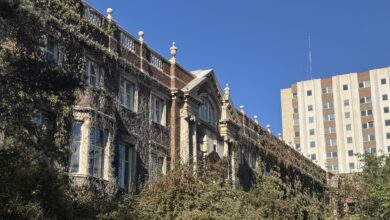
The programs that face the axe first are always the humanities and social sciences. They cost less to cut and provoke less backlash from the industry. At the U of A, this is not theoretical — it is material. The Humanities Centre itself has become a monument to institutional neglect, with outdated furniture, flickering fluorescent lights, malfunctioning infrastructure, and whole semesters of closure due to fire damage. The university equips science, technology, engineering, and mathematics (STEM) buildings with high-tech labs, renovations, and sleek study spaces, yet it tells arts students to accept a “moderate dinginess” standard that allows dirt, dust, and visible dead mice.
This physical neglect mirrors a financial reality: the faculty of arts does not have the premium tuition margins of engineering, nor the international recruitment pull of business or computing science. When international student revenue shrinks, arts becomes the easiest sacrificial target — not because it matters less, but because it is structurally simpler to cut. Institutions push the humanities to do more with fewer resources, even while the fields most connected to democratic literacy, cultural understanding, and social critique face deeper political neglect.
Government officials claim their visa cuts protect international students. They point to abuses in private diploma mills and campus housing scams as proof that international students are being exploited and lied to about work permits. These abuses exist, and they demand consequences. But the response should be regulation, not strangulation. Starving public universities to clamp down on private impostors is like banning bicycles because a scooter rental company cheated tourists.
Domestic students will face the consequences first. They already live in a cost-of-living crisis where rent, groceries, and transportation swallow their financial aid before the semester even begins. Universities are telling them, directly, that a two per cent increase is happening — and that the alternative would mean deteriorating campuses. What tuition covers is blunt: it pays for instructor salaries, study spaces, classroom creation and maintenance, utilities, research that supports instruction, and libraries. Without tuition, the whole physical and intellectual infrastructure collapses.
If Ottawa insists on cutting international visas, it must fund universities like institutions, not like businesses. It cannot demand fewer international students and then refuse to provide operating grants. It cannot force universities to chase efficiencies when those efficiencies mean dissolving language departments, humanities programs, and interdisciplinary research clusters. And it cannot pretend that increases will spare domestic students. Not when it has pulled away one of the primary revenue legs holding the table steady.
What the federal government has done is create a political illusion. They offer struggling renters a scapegoat: international students. They propose a neat solution that costs them nothing, because they do not pay to keep classrooms open. They make universities compensate for national policy failures with higher tuition, larger class sizes, and fewer academic choices. Every level of government has offloaded its responsibilities onto students. Provincial governments refused to fund universities consistently. Municipal governments failed to build affordable housing. And now the federal government is trimming the one population that financially props up the system.
International students deserve protection from fraud. But protection does not mean treating them like numbers to toggle for calmer headlines. The moment the U of A loses them, domestic students are handed the bill. And when domestic students cannot pay that bill, the university does what higher-education institutions always do. It cuts the humanities first.